3rd India Energy Transition Summit: Insights on Solar Energy
Published on March 20, 2025
3rd
India Energy Transition Summit: Insights on Solar Energy
What
is this Energy Transition Summit?
The third
edition of the India Energy Transition Summit organized by FICCI from 29th to
30th January, 2025, in New Delhi is one of its crucial events in
the field of renewable energy, aiming to bring a diverse range of stakeholders,
which includes policymakers, government officials, financial institutions,
technology developers, manufacturers, etc., to collaborate, share
information and knowledge, and develop solutions to fast-track the clean energy
shift. IETS gives a base for initiating critical dialogues and forging
partnerships that can shape the country’s energy transition shift.
What
is the objective of this summit?
The
3rd India Energy Transition Summit (IETS), organized by FICCI, emerged as the
premier platform for directing the complexities of India's energy transition.
It focused to:
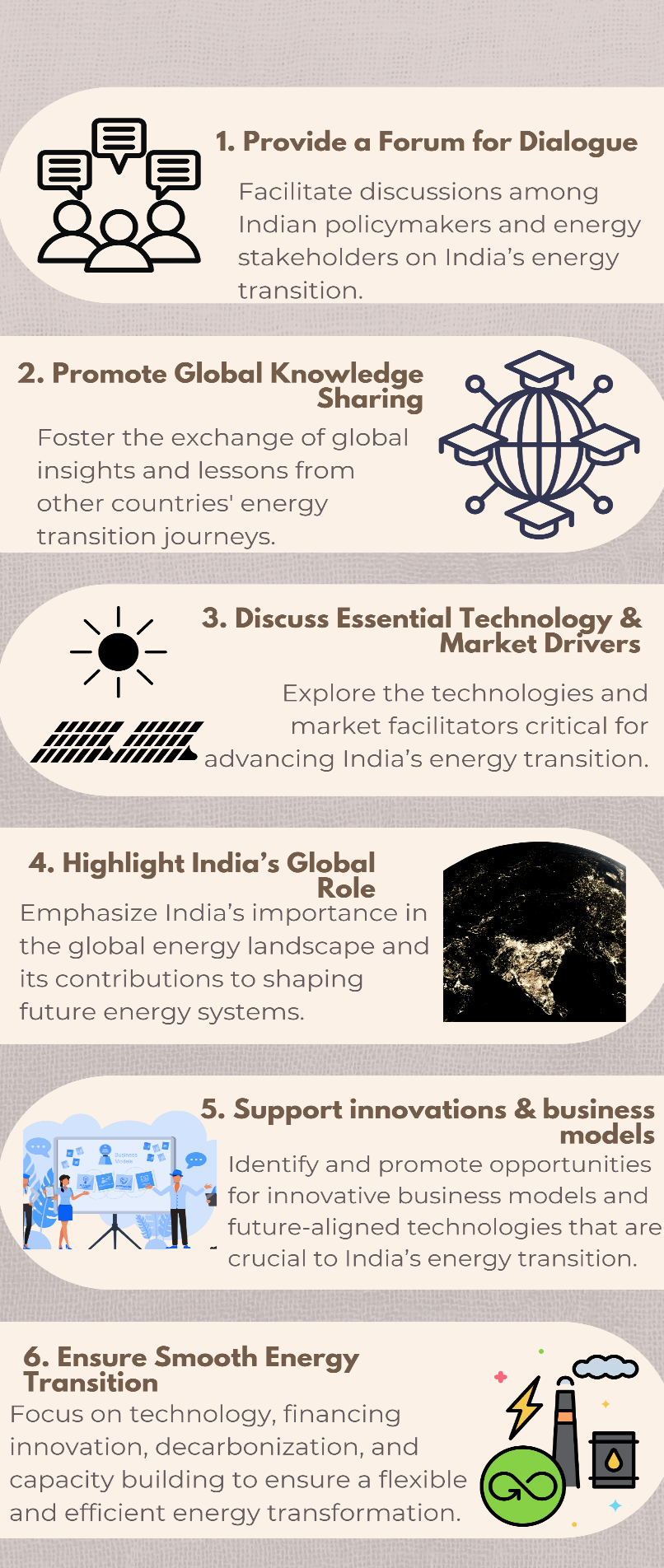
- Facilitate a discussion
forum for Indian policymakers and energy
stakeholders to carefully consider India's energy transition and exchange
global insights and knowledge from the nations in the country’s energy
transition journey.
- Discuss technology and
market facilitators crucial for advancement
in India’s energy transition and emphasize the significance of India’s
energy transition in a global landscape.
- Explore and promote
prospects for different business models and future innovation
aligned with the country’s energy transition to deliver a smooth and
flexible energy transition focusing the technological areas, innovative
financing, decarbonization and capacity building.
The
key areas focused:
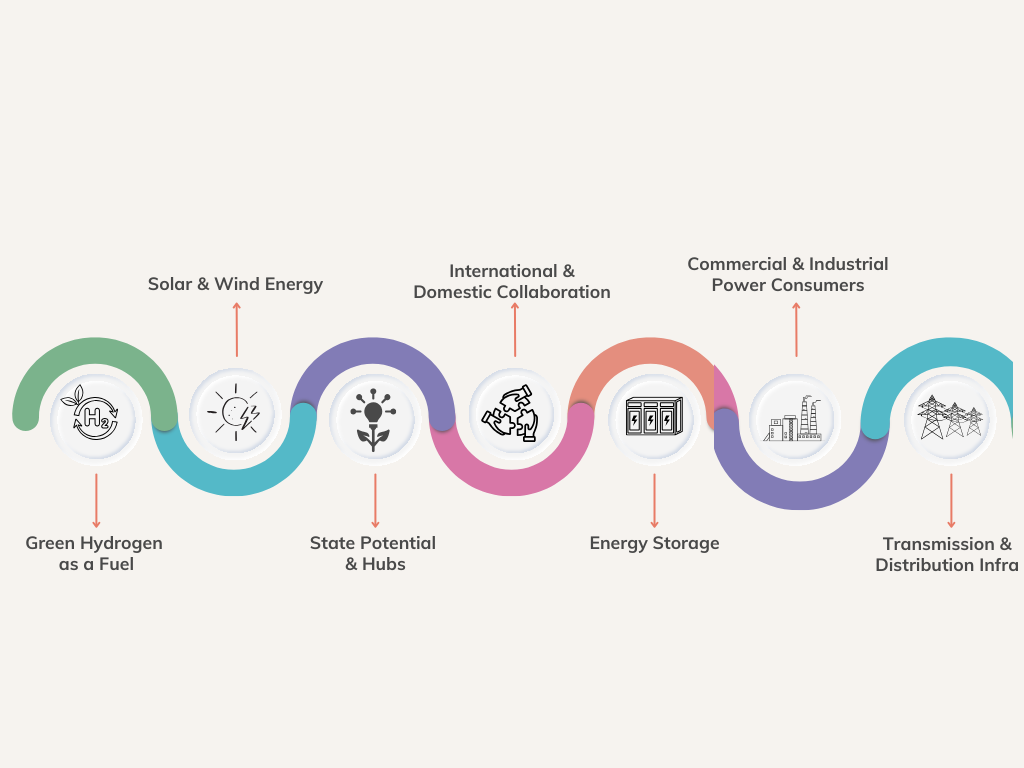
Green
Hydrogen as a fuel: India Energy Transition
Summit (IETS) 2025 aimed to curate advancements in hydrogen production,
storage and its use. Hydrogen as a fuel can emerge as a key pillar for decarbonization
hence, emphasizing its development can prove to be a game changer.
Solar
& Wind Energy Expansion: India aimed to expand its
Solar and Wind energy capacity to meet the target of achieving 500GW
non-fossil energy by 2030 hence encouraging investors into investing
in offshore wind farms and utility scale solar parks.
State
Potential & Renewable Energy Hubs:
Identification of high-potential states for renewable energy is crucial for the
establishment of renewable energy hubs to optimize the country’s energy and
power. For example, Gujarat and Tamil Nadu are high-potential states to
produce Solar and Wind energy.
International
and Domestic Collaboration: Strengthening Global
collaboration can attract foreign investment in India’s renewable energy
sector thus enhancing knowledge exchange and technology transfer.
Energy
Storage: Prime focus is given on the energy storage
system which includes Batteries and Grid-Scale storage systems. It
addressed the issues related to cost, efficiency and scalability of storage
technologies.
Commercial
& Industrial Power Consumers: Formulating
Policies through corporate Power Purchase Agreements that can
encourage the use of renewable energies by industries.
Transmission
& Distribution Infrastructure: Development of
modernized energy grid capable of handling large-scale renewable energy
integration is crucial to attain a sustainable solution.
Policies that can enhance flexibility in the energy distribution network can be
a game changer.
The
Key Discussions and Takeaways of the Energy Summit:
The
New Delhi’s renewable energy conference was inaugurated by Honorable Union
Minister of New & Renewable Energy, Shri Prahlad Joshi, who emphasized
on India’s remarkable progress in Renewable Energy sector. He reaffirmed
India’s renewable targets, the progress in solar installations, and the
financial roadmap for it. Further, the key policy initiatives to boost
domestic manufacturing were discussed.
Reaffirmation
of Renewable Energy Targets:
Addressing
the third India Energy Transition Conference, organized by FICCI in New Delhi,
Shri Prahlad Joshi stated, “India is leading the global energy transition with
unprecedented speed, scale, and scope. India has not only set ambitious energy
transition goals but has also been achieving them at a record pace.”
India
has emerged as a global leader in clean energy and is placed on the third
rank in the global renewable energy market surpassing Brazil. The
country has seen a surge of almost 200% in its renewable energy
capacity. As on 20th Jan 2025, India’s total
non-fossil fuel-based energy capacity has reached 217.62GW.
The significant increase is paving India’s way to achieve 500GW of no-fossil
fuel capacity by 2030. Furthermore, India is committed to an ambitious
target of achieving 1,800GW non-fossil fuel-based energy capacity by 2047.
Progress
in Solar Installations:
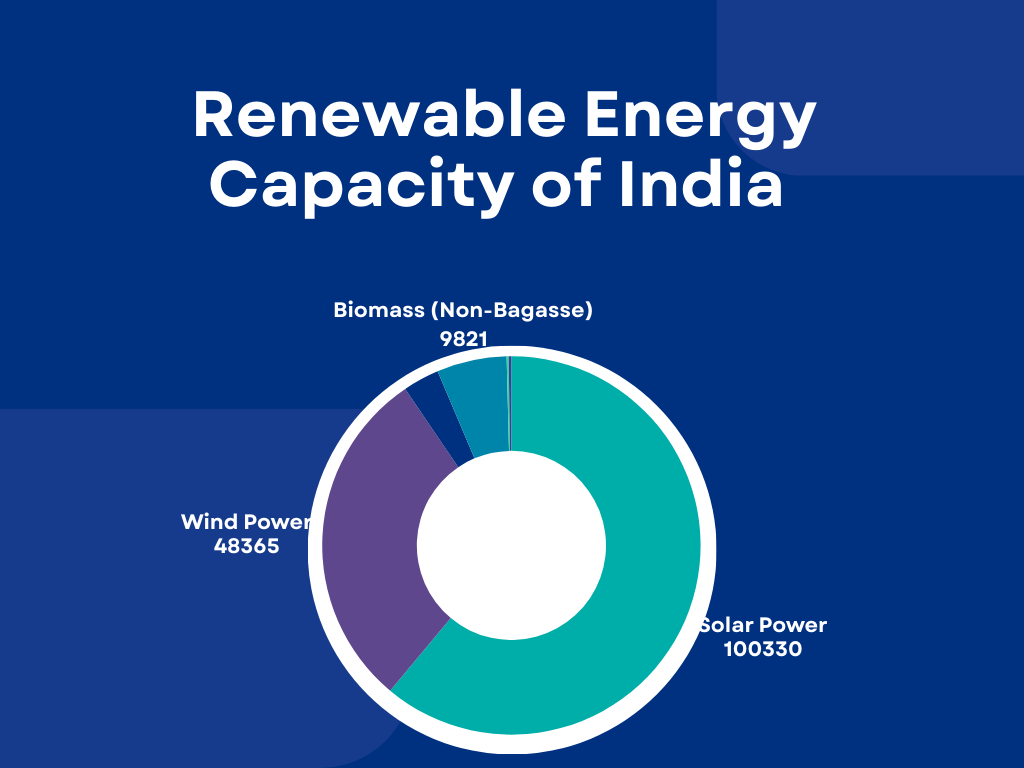
The National
Solar Mission has caused a rapid growth in the solar capacity making it
stand at 100.33GW as of January 2025 with 84.10GW under
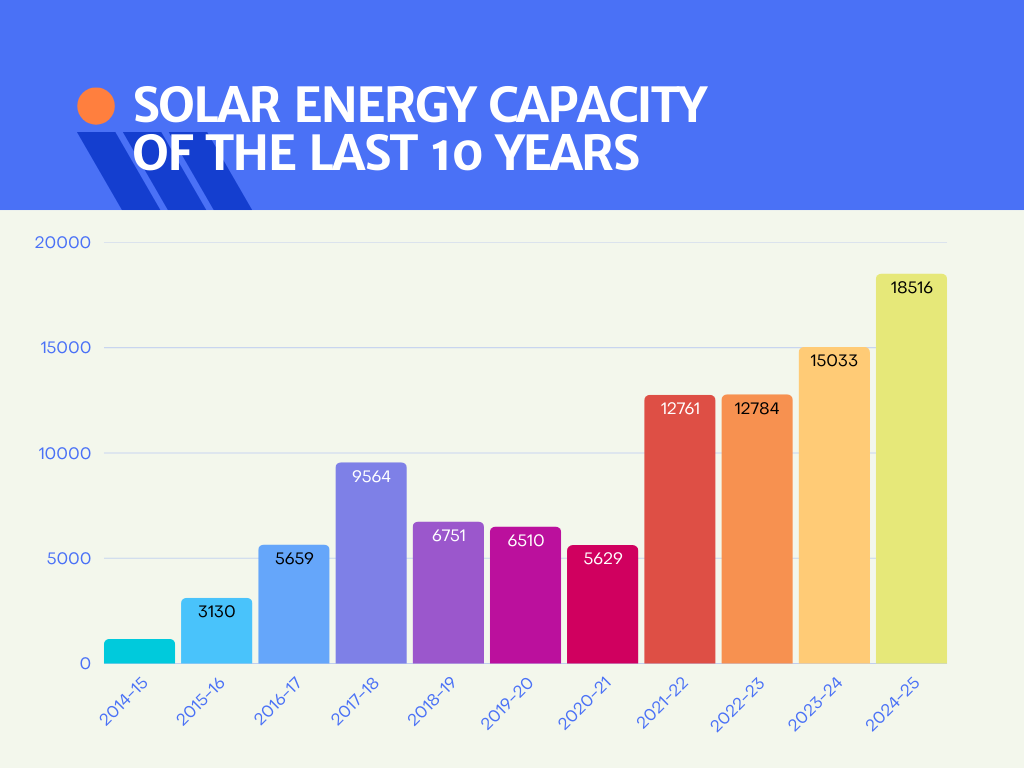
implementation and an additional 47.49GW under tendering. The year 2024
saw a record-breaking addition of 24.5 GW of solar capacity marking a
twofold increase compared to 2023.
Key
drivers like the PM SURYA GHAR: MUFT BIJLI YOJNA which aims to
facilitate the installation of 1 crore rooftop solar panels has
boosted the solar installations in the country, 8.5 lakh of rooftop
solar panels were installed in 2024 adding 1.48GW of solar
capacity.
Rajasthan,
Gujarat, Tamil Nadu, Maharashtra, and Madhya Pradesh
are among the top-performing states, contributing significantly to India’s
total utility-scale solar installations.
Financial
Roadmap for Solar & Wind Energy Expansion:
To
increase its renewable energy capacity 500GW by 2030, India has secured
investments of $386 billion from financial institutions. Out of which ADB
Bank approved $241 million to accelerate the deployment of solar panels and
upgrade necessary infrastructures.
Additionally,
in 2024, the government announced PM SURYA GHAR YOJNA by allocating a budget
of Rs. 75,021 crores to install more than 1crore rooftop solar
panels.
Potential
Challenges and Opportunities:
India
has seen a surge in the solar power capacity over a few years however, the
total energy output has not been substantial. Despite the 25.8 GW capacity addition, solar energy has
contributed an average annual power output of only 15%.
The solar radiation has been significantly low in 2024 because of much better
monsoon than expected causing low energy output.
However,
amidst the challenge with low energy output, it is anticipated that with the improved
solar capacity addition the country would see a boom in its solar
energy output. With better regulation, policies, storage and distribution
of solar energy, the country is set to become a ‘Solar Powerhouse’ in
the coming years.