Why Saving Forests Is Our Most Urgent Climate Solution
Published on November 25, 2025
Why Saving Forests Is
Our Most Urgent Climate Solution
Forests
are often called as the lungs of our planet. They have a role in carbon
sequestration which is the process of catching and storing of carbon dioxide
(CO₂)
from the atmosphere. Trees absorb CO₂ through photosynthesis, duly helping in offsetting carbon
emissions from industries, transportation, plus human activities. Nonetheless,
with higher global temperatures, rapid deforestation, as well as increased
greenhouse gas emissions, the capability of forests to serve as carbon sinks is
under severe threat.
Forests,
as stated by the IPCC (2023), take in nearly 7.6 billion metric tons of CO₂ each year, about 30% of global
emissions from fossil fuels. Despite this fact, clearing forests and forest
damage send tons of carbon to air again, speeding warming. Protecting and
restoring forests is among the most effective solutions to reducing climate
change. However, precisely how do trees hold and save carbon, and why is forest
preservation so important when fighting climate change?
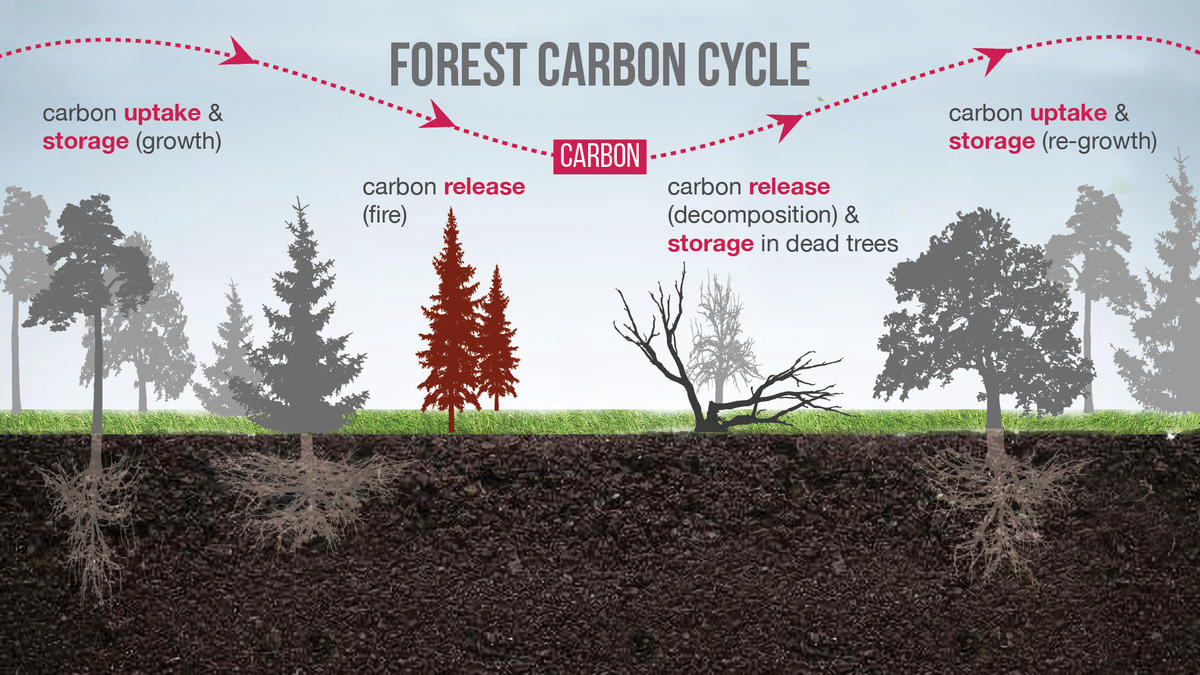
Image Credit: cary institute
The Science of Carbon
Sequestration: How Trees Absorb Carbon
The
carbon sequestration process happens via photosynthesis; trees take in CO₂, sunlight, plus water and then produce
oxygen and glucose. This perpetually traps carbon within tree biomass,
including within the entire trunk, branches, roots, and leaves. Quantities of
this carbon are also transferred to the soil, in which it stays stored for
decades or even for centuries.
A
mature tree can absorb up to 48 pounds (22 kg) of CO₂ during each year, while an acre of
forest can sequester around 2.6 metric tons of CO₂ on an annual basis (U.S. Department of
Agriculture, 2023). The carbon completely remains locked directly away until
the tree fully dies, extensively decays, or it is entirely burned, at which
exact point in time the already stored carbon is immediately released back into
the atmosphere.
Not
all forests sequester carbon at the same rate. Different types of forests play
unique roles in the global carbon cycle, with some acting as short-term
absorbers and others as long-term storage units.
(Self-designed Image)
Types of Forests and Their Role
in Carbon Sequestration
1. Tropical Rainforests: The Largest
Carbon Sink
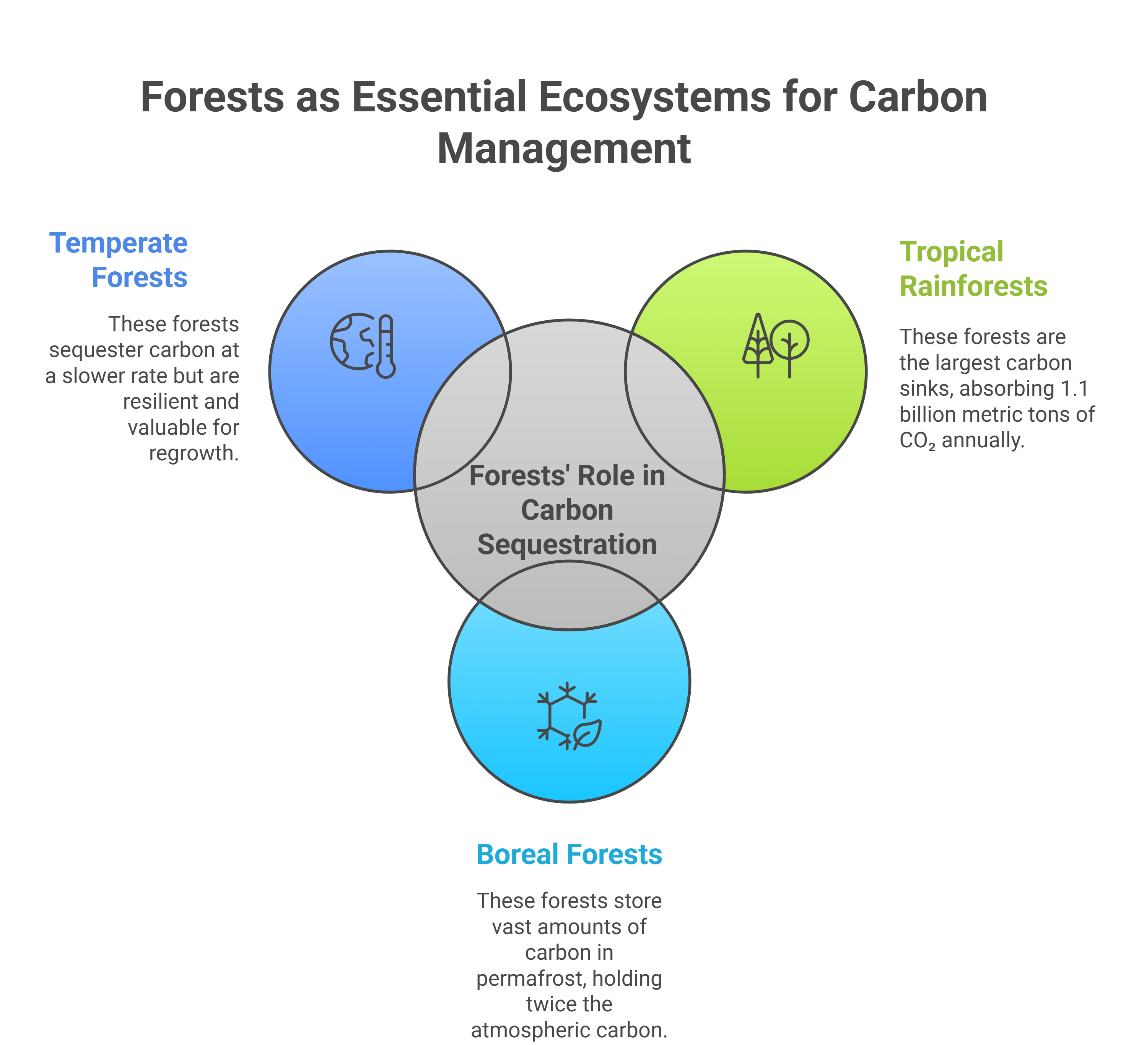
Tropical rainforests, like the Amazon, Congo Basin, as well as Southeast Asian forests, are the most powerful carbon sinks on Earth. They carefully absorb around 1.1 billion metric tons of CO₂ annually (World Resources Institute, 2023). They steadily, in addition, can store up to 250 metric tons of carbon per hectare. However, they are also highly vulnerable to deforestation, with over 17% of the Amazon Rainforest lost in the past 50 years.
2. Boreal Forests: The Long-Term Carbon
Vault
Boreal forests located in Canada, Russia, Scandinavia, along with Alaska, hold most of their carbon underground in permafrost and soil layers. These forests roughly hold up to 703 gigatons of carbon. That is twice as much as that from the atmosphere (IPCC, 2023). With global temperatures on the rise, melting permafrost is releasing stored carbon, so boreal forests are both a carbon sink as well as a potential carbon source.
3. Temperate Forests: Regrowth
Powerhouses
Temperate forests, found all through North America, Europe, along with East Asia, sequester carbon at a bit slower rate but are resilient to the climates change. With adequate management along with wide-ranging reforestation efforts, they can be replenished rapidly, making them helpful for sustained carbon catch strategies.
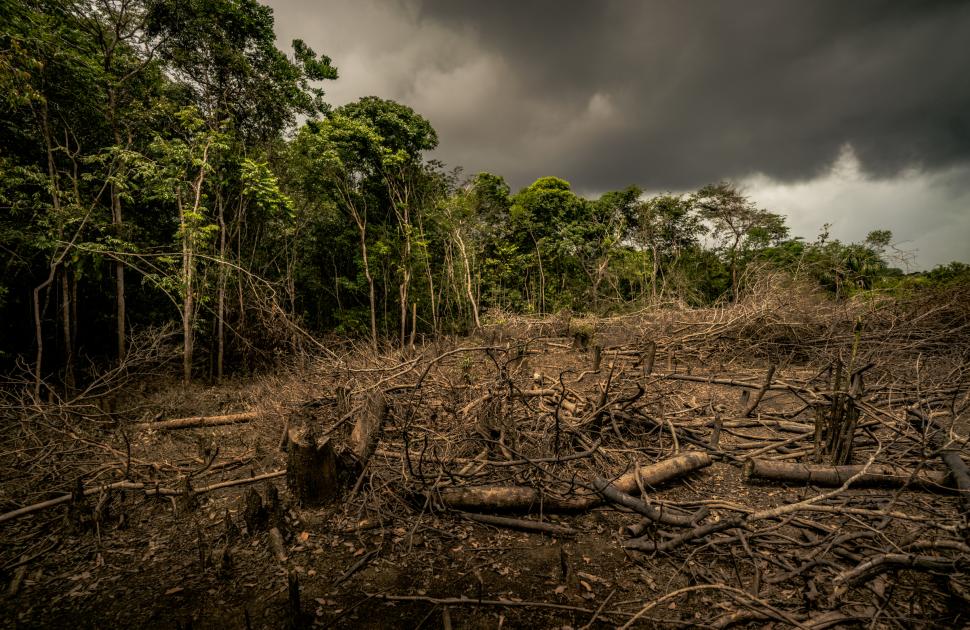
Image Credits: wwf
Deforestation: The Carbon Crisis
We Can’t Ignore
Despite the critical role forests play in regulation of CO₂, they are disappearing at an alarming rate. Each year, the World Bank (2023) approximates 10 million hectares of forest disappear; deforestation, in addition, accounts for 10-15% of worldwide carbon emissions.
Main Causes of Deforestation and Its
Carbon Impact:
- Agricultural Expansion
– Nearly 80% of deforestation is caused by cattle ranching,
palm oil plantations, and soy farming.
- Illegal Logging
– Drives Forest degradation and disrupts carbon storage.
- Urbanization
– Rapid city expansion leads to massive deforestation.
- Forest Fires
– Increasingly severe due to climate change, releasing billions of tons of
CO₂.
Deforestation not only adds to carbon emissions; it also decimates biodiversity plus interferes with water cycles, and uproots native settlements. Avoiding deforestation along with restoring degraded forests constitutes a key strategy for carbon sequestration. It is also a key approach toward climate change mitigation.
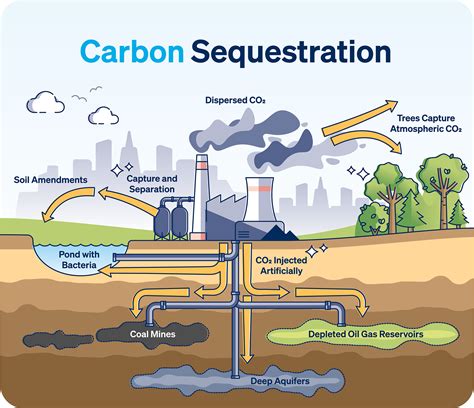
Image Credit: amwins
Enhancing Carbon Sequestration:
Key Solutions
To best use forests for climate benefits, revolutionary reforestation strategies, forest management techniques, and carbon credit systems must be adopted.
1. Reforestation and Afforestation
To increase carbon sequestration, reforestation along with afforestation are several key answers. China’s "Great Green Wall" project has extensively planted beyond 66 billion trees. It is all for combating desertification and improved carbon absorption.
2. Sustainable Forest Management
Instead of complete deforestation, selective logging along with rotational forestry help in maintaining of forest cover, as they allow economic activity. Agroforestry, where trees are planted with multiple crops, increases overall carbon sequestration, plus farm output.
3. Carbon Offset Programs
A collection of carbon offset schemes get funds from firms and governments, thereby funding forest conservation using carbon credits. The Amazon Rainforest Protection Initiative is an example of large-scale investment in forest restoration to balance carbon emissions.
4. Biochar: A Long-Term Carbon Storage
Solution
Biochar is a material produced by burning organic plant waste at high temperatures in a low-oxygen environment. This class firmly locks up carbon within soil as a lasting form over time, mostly helping toward cutting of airborne CO₂ while building upon soil fertility.
5. AI & Satellite Monitoring for
Forest Protection
Advanced technology is used to monitor deforestation and unlawful logging as it happens. AI-powered satellite imaging detecting carbon losses lets governments as well as conservationists act before deforestation spreads further.

Image Credits: UNDP Climate Promise
The Future of Forest Conservation
in Climate Policy
Forests
do more than store carbon—they are important to planetary survival. As per the
United Nations (2023), restoring nearly 350 million hectares of degraded forest
could sequester about 26 gigatons of CO₂ by 2030. However, global leaders must commit themselves to
strengthen forest protection policies, sustainable land use in perpetuity, and
specific carbon pricing mechanisms so as to incentivize conservation actions.
The European Union’s Green Deal and the U.S. Inflation Reduction Act (2022) introduced incentives for reforestations as well as forestry. Countries like Norway and Costa Rica have committed to net-zero deforestation policies.
Why We Must Act Now
Without
urgent action, deforestation could push on the planet past the 1.5°C warming
threshold, causing irreversible climate consequences. Safeguarding forests is
not just about preserving trees; it is about assuring a sustainable future for
humanity.
Forests
are our greatest
natural climate solution—but
will we protect them in time?