Environment Conservation
Published on August 11, 2026
ENVIRONMENTAL CONSERVATION!
I chose environmental conservation for one
simple reason: it begins with a question. Why are we doing this?
We often hear environmentalists and
conservationists refer to our planet as "Mother Earth." She
nurtures not just humans, but every living being, providing us with air, water,
food, and everything we need to survive. If we love and care for our biological
mother, why don't we show the same respect and responsibility towards Mother
Earth? What is stopping us?
I still haven't found a convincing answer.
Perhaps the answer lies not in what we know, but in what we choose to do.
As I searched for answers, I realized a simple
truth: for decades, we have consumed forests, water, and other natural
resources as if they were unlimited. In the name of growth and urbanization,
forests have been cleared and ecosystems sacrificed for infrastructure. While
development is essential, it loses its meaning if the very environment that
sustains human life is destroyed.
The same applies to fossil fuels. Just because
they are available today does not mean they will last forever. Nature has
limits, and the environmental challenges we face today are the consequences of
ignoring them.
We may all have heard in the daily news that
Europe is experiencing some of its worst climate conditions in decades. Roads
are melting, people are struggling with extreme heat, and many are rushing to
shops to buy air conditioners. People never seem to learn or change. Why don't
they realize that, instead of relying only on temporary solutions, they can
also plant trees?
Literacy rates are high in Europe, but what is
the use of education if it is not put into practice, right?
Let me explain how the cycle works:
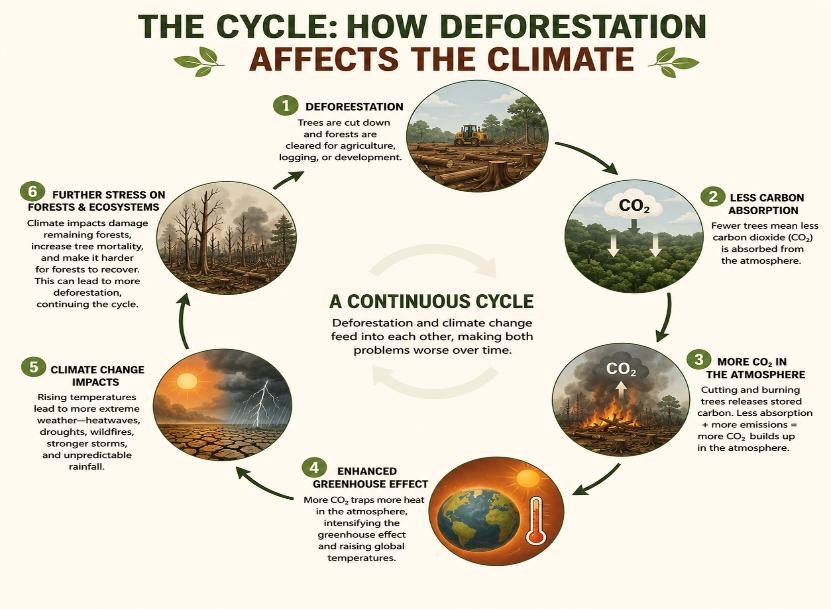
Conserving
forests, wetlands, and other natural ecosystems is one of the key ways to
reduce climate impacts. However, decades of habitat loss and greenhouse gas
emissions have made such events more severe.
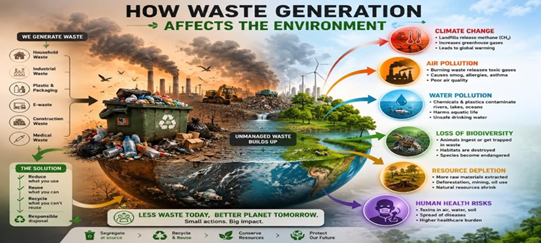
Not recycling
waste is one of the hidden culprits that harms humans more directly than we can
imagine. Want to know how? Where do you think all the waste goes? It never
truly leaves! It's beneath you, affecting you little by little.
Waste
accumulates in landfills, which, in turn, release toxic fumes into the
atmosphere and contaminants into the soil that can persist for generations.
One thing I am proud of is that I work in the renewable energy industry, which
is one of the best alternatives to power generation from non-renewable sources.
Apart from this, what else can we do?
This time, I
searched for solutions rather than answers, and so far, I have found a few
steps that can help reverse these impacts: environmental conservation.
By now, you probably know why I chose this topic.
Just as
governments enforce strict laws against serious crimes like murder, similarly,
strict environmental laws must be implemented to ensure the success of this
initiative. Here are a few measures that I believe are practical and
achievable:
• Afforestation
• Waste recycling
• Strict environmental laws
• Public awareness about the environmental impacts that will follow if we fail
to act
Recently, the
European Union approved the Nature Restoration Law, which focuses on restoring
rivers and forests. Why can't such initiatives be adopted globally? What is
stopping us?
Most Western
countries have realized the need for environmental conservation. In India,
however, the journey is still ongoing. As a citizen, I want to make a
difference in my society, and as a small step, I have joined and am actively
campaigning for environmental conservation. People like me are working
everywhere for the very reason I am writing this article.
Just as I take
good care of my mother at home, I will take good care of my EARTH in
this entire solar system!
Environmental
conservation is the key to answering all these questions. The term itself may
seem complicated, but it is really that simple. Reducing the use of fossil
fuels and opting for alternative energy sources, such as renewable energy, will
help reduce carbon emissions in the atmosphere. Everything is interconnected.
If we can
reduce the impact of carbon emissions, it will help stabilize the climate,
reduce the intensity of heat waves, and support more balanced seasonal
rainfall.
It all lies in
a seed. Just imagine how planting a single sapling and nurturing it until it
becomes a tree can positively impact the Earth. Surprising, isn't it?
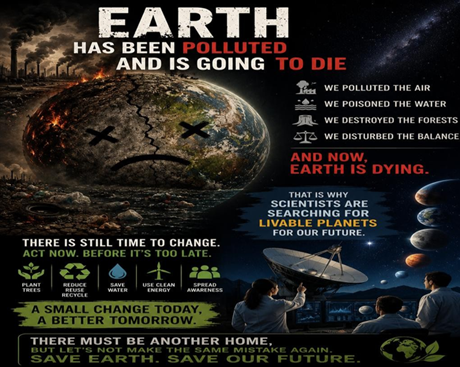
Society has
become so obsessed with money that, for many people, it seems to be the only
priority. I used to think that scientists around the world know they cannot
single-handedly educate everyone or make people realize the damage being done
to Earth, and that is why they are also exploring the possibility of refuge on
another planet, such as Mars.
No matter how
many governments change, the need for environmental protection and waste
management never changes. Surprisingly, not enough concern is being raised
about these issues that affect everyone's day-to-day life.
It is our
responsibility to raise awareness about these impacts and adopt energy from
renewable sources. Although we are already working with wind, solar, and
hydropower, the search for cleaner and more sustainable alternatives never
ends.
The reason why
governments are now bowing their heads is that they know they have failed. El
Niño has made them realize the seriousness of the situation. Whenever Earth is
under stress, its natural systems respond. I see El Niño, along with volcanic
eruptions and earthquakes, as part of Earth's immune system. So, what will the
antibodies be?
Every policy
change and every individual's responsibility will act together to protect both
the planet and ourselves. By working together and staying committed to
sustainable practices, we can protect our natural resources and create a safer
world for future generations.
Remember:
EARTH CAN SURVIVE WITHOUT US, BUT WE CANNOT SURVIVE WITHOUT EARTH!
As an engineer
in the renewable energy sector, I realized the responsibility on my shoulders
to bring about positive change through environmental conservation. I have
always wanted to come up with new ideas to contribute to this cause.
That is when I
was introduced to IDREA through my organization, and I look forward to
collaborating with them on more awareness programs to bring about meaningful
change.
Are you with
me?
Author
Sanjay Kumar
Ramadass is an Assistant Project Manager and
Karnataka Cluster Manager in the renewable energy sector, with a degree in
Civil Engineering and 13 years of professional experience in the field.
Energetic and passionate about environmental conservation and sustainable
practices, he is committed to promoting environmental responsibility across
project sites and teams. He is an active participant in IDREA activities and
contributes to various awareness, engagement, and knowledge-sharing initiatives
aimed at fostering a culture of sustainability and environmental stewardship.