Europe's 2025 Heatwave: A Deadly Warning Fueled by Climate Change
Published on May 12, 2025
Europe's 2025 Heatwave: A Deadly Warning Fueled by Climate Change
🔥 An Unprecedented Start
to Summer
Europe's 2025 summer began with alarming intensity. Even before the official start of the season, record-breaking heatwaves swept across Western and Southern Europe, marking June 2025 as the hottest June ever recorded across the continent. Temperatures soared to 46.6 °C in Portugal, over 40 °C in Spain and France, and between 38–44 °C in Greece and Turkey, pushing public health systems and infrastructure to the brink.
This early onset of extreme heat—weeks ahead of the typical summer peak—was a clear indicator of the accelerating impact of climate change, with Europe now warming twice as fast as the global average.
🌍 The Climate Science
Behind the Heat
Meteorologists and climate scientists attribute the intense heat to several overlapping factors:
- Persistent heat domes: High-pressure systems locked hot air over the continent, preventing heat from dissipating.
- Warming seas: The Mediterranean Sea was measured at nearly 6 °C above normal, intensifying the surrounding air temperatures.
- Urban heat island effect: Cities with dense infrastructure and limited green cover retained heat longer into the night, especially affecting the vulnerable.
- Declining Arctic ice: Melting Arctic ice is altering jet stream patterns, leading to longer, more stationary high-pressure systems that prolong heatwaves.
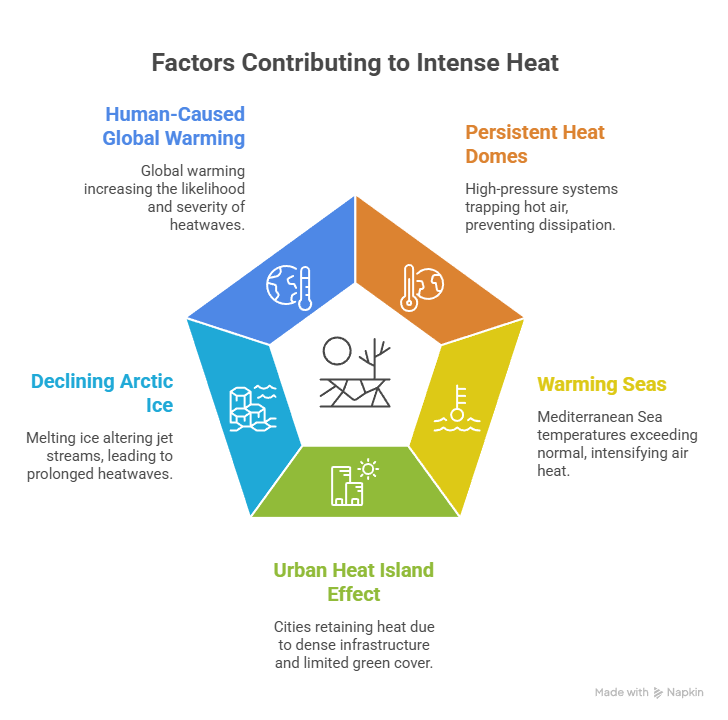
Climate attribution studies have already confirmed that human-caused global warming made this heatwave significantly more likely and more deadly, with experts suggesting that up to two-thirds of the heat-related deaths were worsened by climate change.
🩺 Human Impact: A Rising
Death Toll
The 10-day heatwave in late June and early July resulted in a staggering 2,300 excess deaths across Western Europe:
- Spain: ~1,180 deaths
- UK: ~570 deaths
- Portugal: ~284 deaths
- Additional fatalities were reported in France, Italy, Turkey, and Greece.
Hospitals and emergency services were overwhelmed, especially in regions where homes lack proper insulation or air conditioning—common in countries like Portugal, where over half the population experiences uncomfortable indoor temperatures during both summer and winter.
🌲 Forest Fires and
Environmental Disasters
The extreme heat also triggered widespread wildfires:
- Greece: Flames ravaged the island of Crete, forcing the evacuation of over 1,000 residents. Near Athens, wildfires threatened residential neighborhoods, fueled by dry vegetation and hot winds.
- Turkey: Reported 761 wildfires since late June, with tragic fatalities including a forestry worker and an elderly resident in Izmir Province.
- Spain and Italy also saw multiple wildfire outbreaks, placing further stress on emergency services already stretched by the heatwave.
These fires underscore the growing overlap between climate-driven heatwaves and disaster events, with prolonged droughts, wind, and human activity contributing to rapid wildfire spread.
🏛️ Social
Response: Climate Shelters and Public Warnings
European cities took varying approaches to protect citizens:
- Barcelona is a regional leader, offering over 400 designated climate shelters—public facilities like libraries and schools with water, seating, toilets, and shade.
- Lisbon, despite facing high mortality and thermal discomfort, had yet to implement a formal shelter network. However, local researchers have identified possible locations including fountains, shaded parks, and museums.
- Governments across France, Italy, the UK, and Spain issued hundreds of red and orange heat alerts, closed schools, limited outdoor work, and encouraged people to stay indoors.
But access to cooling spaces remained uneven, especially among the poor, elderly, and migrants—raising concerns about climate justice in the face of escalating extremes.
🧭 A New Normal for Europe
What once was considered extreme is now becoming routine. The early and deadly heatwave of 2025 confirms what climate experts have long warned: Europe must urgently adapt to more frequent, intense, and longer-lasting heatwaves.
This means:
- Improving building insulation and urban design
- Expanding access to cooling centers and green spaces
- Investing in wildfire prevention and response
- Mapping climate risks and improving early-warning systems
Above all, these events reinforce the need to reduce global emissions. Without significant mitigation, such heatwaves are expected to increase tenfold by the end of the century—threatening lives, ecosystems, and infrastructure across the continent.
🔚 Conclusion
Europe’s 2025 heatwave is more than a weather anomaly—it is a climate crisis manifesting in real time. It has taken lives, scorched forests, tested governments, and issued a stark warning: adaptation is essential, but mitigation is non-negotiable. The heat is not just on the streets of Europe—it’s on the decisions made by leaders, cities, and citizens in the fight against climate change.