LPG Conservation: Efficiency, Alternatives, and Sustainability
Published on March 30, 2026
LPG Conservation: Efficiency, Alternatives, and Sustainability
Across
India, familiar kitchen sounds are going quiet. The morning chai, the sizzling
tawa, the pressure cooker's whistle - all being stretched as households ration
what remains in their last cylinders.
This is
not merely an inconvenience. It is a signal - and an opportunity.
India
imports 60% of its LPG, with 90% of that supply flowing through a single
maritime chokepoint. The current disruption has made starkly visible what
energy experts have warned for years: this structural vulnerability was always
a crisis waiting to happen. The time to act on sustainable alternatives is now.
What's Happening Right Now?
India is
facing a severe LPG shortage triggered by disruptions in the Strait of Hormuz -
a key global energy shipping route caught in the crossfire of escalating
geopolitical tensions.
What makes
this crisis different is how deeply it has entered everyday life:
- A mandatory 25-day gap between
LPG bookings has been enforced to manage demand
- Commercial LPG supply has been
suspended in several cities, including Mumbai, Bengaluru, and Kolkata
- Piped Natural Gas (PNG) households
have been directed to surrender LPG connections to prioritise supply for
others
- Gujarat has restricted commercial LPG usage to 20% while
distributing kerosene as a backup fuel
- Restaurants, hostels, and
canteens are cutting operations or reworking menus entirely
Diplomatic
efforts have secured some short-term supply, but the underlying vulnerability
remains unaddressed.
Why Your
Kitchen Is Feeling It
The Strait
of Hormuz carries an estimated 20 million barrels of oil per day globally.
India's entire LPG import pipeline flows through it - and the country's
underground storage capacity stands at only 1.4 lakh tonnes, covering less than
half a month's consumption.
Unlike
crude oil, where India maintains roughly two months of strategic reserves, LPG
infrastructure is built for continuous flow, not emergencies. That gap is what
this crisis has violently exposed.
With over
30 crore LPG connections nationwide and average household consumption of 6-8
cylinders per year, even small efficiency improvements at the household level
can translate into substantial national-level savings during a supply crisis.
Why This Is a Sustainability Wake-Up Call
The LPG
shortage points to a deeper, longer-standing problem: India's dependence on a
centralised, fossil-fuel-based system for one of its most basic needs -
cooking.
Even
setting aside supply risk, LPG still emits carbon, depends on imports, and
remains exposed to price volatility and geopolitical shocks. That makes it
unsustainable in the long run - environmentally and economically.
A forced
shift back to traditional fuels such as firewood or kerosene risks reversing
years of progress in clean cooking. This could significantly increase indoor
air pollution and associated respiratory illnesses, particularly among women
and children who are most exposed to household cooking environments.
The impact
is particularly severe for beneficiaries of the Pradhan Mantri Ujjwala Yojana,
where LPG access has improved clean cooking adoption across millions of
households. However, affordability and supply stability remain critical
challenges, and disruptions like this risk pushing vulnerable households back
to polluting alternatives.
While
urban households are facing immediate supply disruptions, rural India may
display relatively greater short-term resilience due to continued use of mixed
fuel systems. However, this often comes at the cost of reverting to less clean,
less efficient fuels, highlighting an uneven transition across regions.
If every
household reduces LPG consumption by just 10%, the cumulative impact could
significantly ease supply pressure and improve availability for those with no
viable alternatives.
The crisis
is not just a supply problem. It is a prompt to rethink how we cook and consume
energy.
5 Ways to Conserve LPG - Starting Today
Every
cylinder saved is one more available to a household with no alternative. These
are practical, immediate actions - not distant goals.
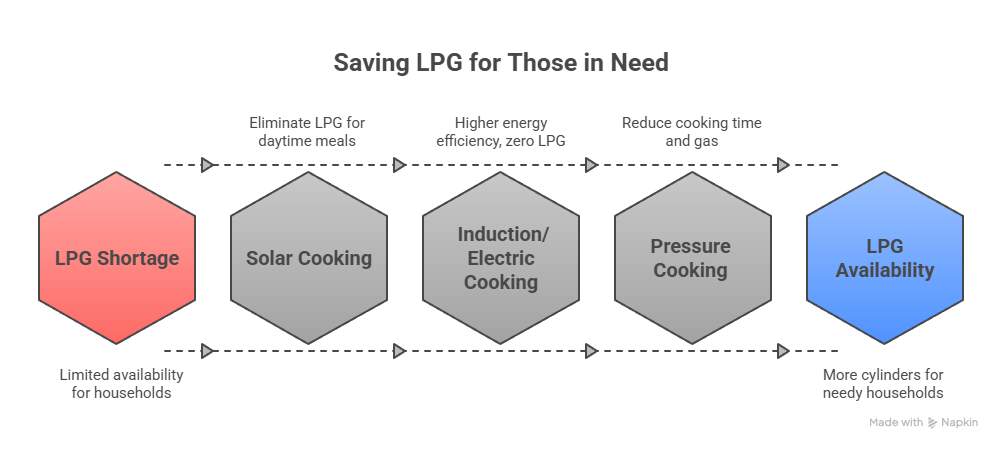
1.
Solar Cooking: A
box-type solar cooker eliminates LPG entirely for daytime meals. Available at
low cost and capable of cooking rice, dal, and vegetables - ideal for India's
March–June climate.
2.
Induction or Electric Cooking:
Induction stoves operate at 85–90% energy efficiency, compared to roughly 60%
for LPG burners. As India's power grid gets progressively cleaner, electric
cooking becomes a greener - and zero-LPG - option. Budget models start from
around ₹1,200 and can pay back within three to four months at current
prices. While induction and electric cooking present a viable alternative,
scaling them effectively will require parallel improvements in grid
reliability, affordability, and last-mile connectivity, particularly in
semi-urban and rural regions.
3.
Pressure Cooking Everything:
Cuts cooking time for dal, rice, and legumes by up to 70% - directly reducing
gas consumption. This is the single highest-impact, zero-cost change most
households can make right now.
4.
Flame Discipline:
Match burner size to pot size. Keep lids on. Simmer rather than boil hard. Turn
off the flame two minutes before food is done. These small habits compound to
20–25% savings across a month.
5.
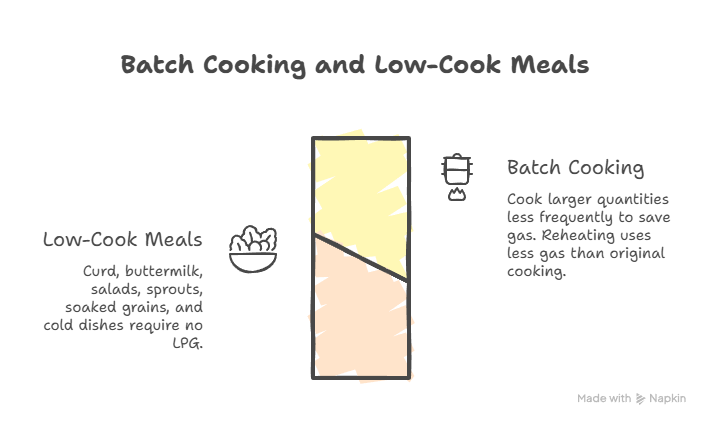
Batch Cooking & Low-cook / No-cook meals: Cook larger quantities less frequently. Reheating
uses a fraction of the gas that original cooking requires. Hostels and canteens
across the country are already pivoting to this model during the current
shortage. Curd, buttermilk, salads, sprouts, soaked grains, and cold dishes
require no LPG at all. Kitchens across Gujarat and Karnataka are already
leaning on these options to stretch supplies.
The Next Shift: Smarter Energy for Cooking
1. BioLPG - A Drop-In, Low-Carbon
Alternative
BioLPG,
derived from vegetable oils, waste fats, and agricultural residues, is
chemically identical to conventional LPG. It works in existing appliances
without any modification and can reduce lifecycle emissions by up to 80–90%
depending on feedstock and process.
Already
produced at commercial scale in Europe - with Rotterdam's Neste refinery among the leading facilities -
BioLPG is gradually expanding toward Asian markets. The current crisis makes
the case for accelerating that transition.
2. Biogas - Local, Decentralised, and
Circular
Biogas is
one of India's most practical and underutilised cooking energy alternatives.
Produced from kitchen scraps, agricultural waste, and cattle dung, it generates
cooking fuel while simultaneously producing organic fertiliser - closing the
waste loop entirely.
At the
household level, prefabricated biogas units are already in use across rural
India, with families paying ₹200–300 per month compared to ₹700+
per LPG cylinder. At scale, Compressed Biogas (CBG) is emerging as a strategic
alternative - with approximately 150-200 CBG plants under development or
commissioning under the governments SATAT and GOBARdhan initiatives.
GOBARdhan
subsidies of up to ₹37,000 make adoption more accessible than ever.
Unlike
imported LPG, biogas is locally produced, supply-chain independent, and
carbon-neutral in its lifecycle. In the context of the current crisis, it
represents exactly the kind of decentralised, resilient energy solution India
needs to build toward.
3.
Infrastructure and Policy: Progress with Gaps
India's
installed renewable energy capacity has crossed 266 GW as of early 2026,
signalling serious momentum in the clean energy transition. On the LPG side,
infrastructure is also evolving:
- Underground LPG storage
facilities at Mangaluru and Visakhapatnam are being expanded
- India has signed a 2.2 MTPA
LPG import deal with the US, alongside diversification toward Russia,
Norway, and other suppliers
- Refinery optimisation is being
used to increase domestic LPG output
Progress
is real - but the International Energy Agency has consistently flagged India's
limited strategic LPG storage as a key vulnerability. That gap still needs to
be addressed with urgency.
Reducing
dependence on LPG also aligns with India’s broader climate commitments,
including its net-zero ambitions and the ongoing push towards electrification
and renewable energy integration across sectors.
From Crisis to Course Correction
This 2026
LPG crisis not as a disruption to manage, but as a turning point to act on.
What our
kitchens are experiencing today reflects a larger structural gap - energy
systems built on imported fossil fuels and centralised supply chains are
inherently fragile. The path forward is not simply increasing supply. It is
reducing dependence.
That means
accelerating the shift toward decentralised solutions like solar and biogas,
scaling alternatives such as BioLPG, and embedding efficiency into everyday
habits.
The most resilient energy system is
not just one that supplies energy, but one that reduces dependence, distributes
risk, and builds local sustainability. This crisis is not just a warning; it is
a blueprint for what must come next.