Repowering Wind Farms: Upgrading for a Stronger Renewable Future
Published on August 15, 2025
Repowering Wind Farms:
Upgrading for a Stronger Renewable Future
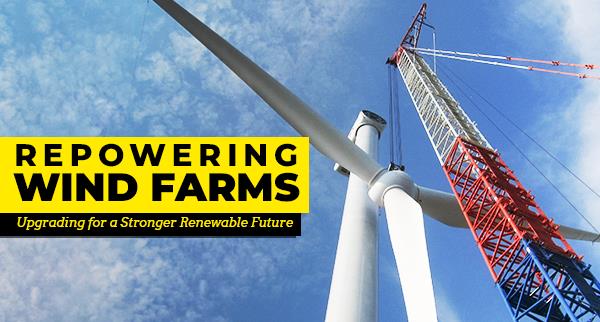
As the global demand for renewable energy
continues to rise, repowering aging wind farms has become an effective strategy
to increase energy output and improve the efficiency of existing
infrastructure. Repowering involves upgrading or replacing older wind turbines
with modern, more efficient models. This approach not only boosts energy
generation and extends the operational life of existing sites but also delays
or avoids the need for decommissioning old wind turbines, making better use of
already developed land and resources.
Approaches to
Repowering Wind Farms
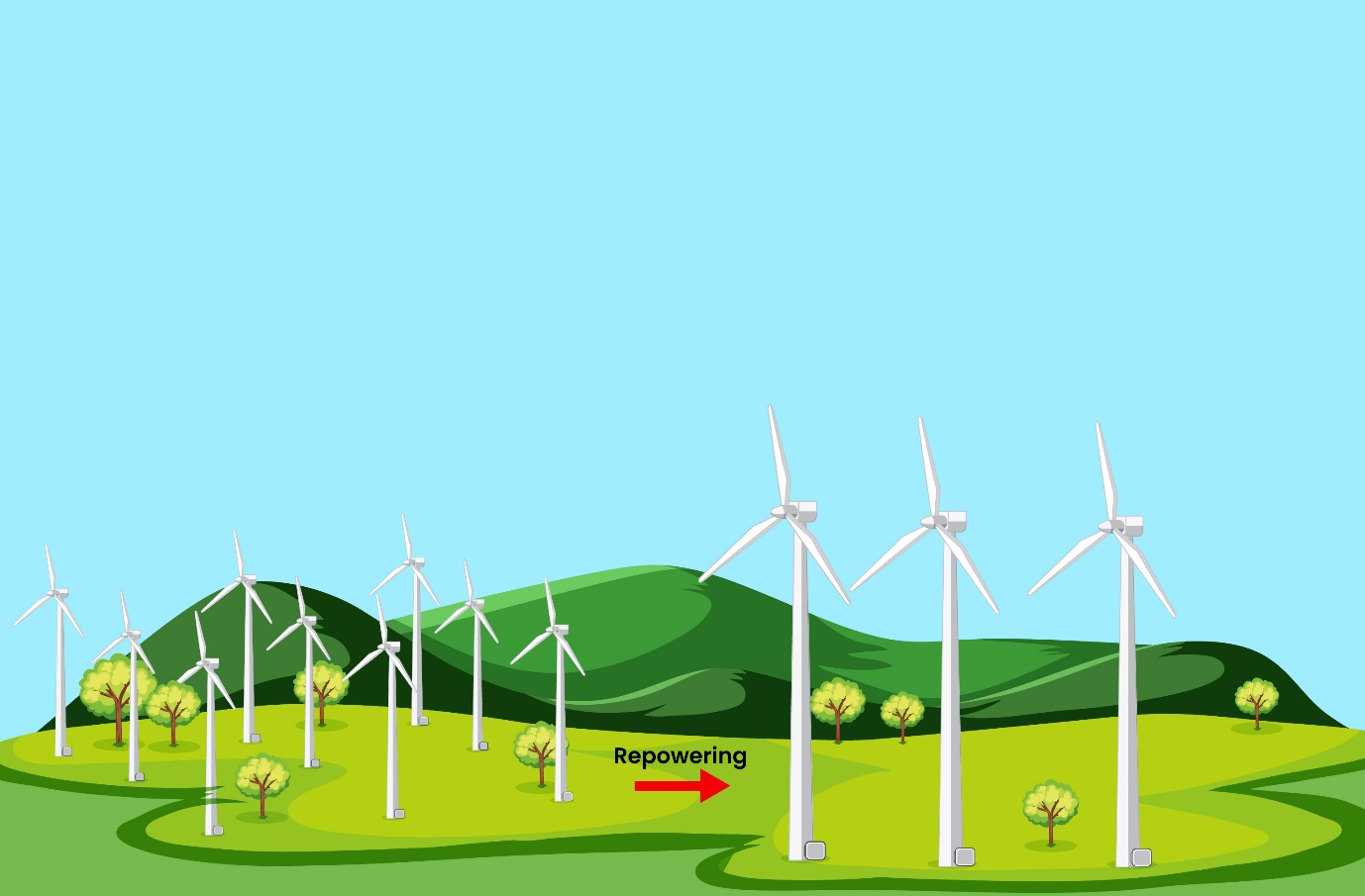
- Partial Repowering: This involves
upgrading particular components from existing turbines, such as their
rotor blades, gearboxes, and control systems, to increase performance and
reliability without completely replacing the turbine's full structure.
- Full Repowering: This strategy
involves removing older turbines and fitting newer, stronger units.
Complete repowering often results in a reduction in the number of turbines
on the very site, but with considerably increased total capacity, as well
as energy output.
By implementing each of these strategies, wind
farms can achieve comparably higher efficiency, in addition to productivity.
The farms can make even better use of existing sites, along with infrastructure.
Benefits of Repowering
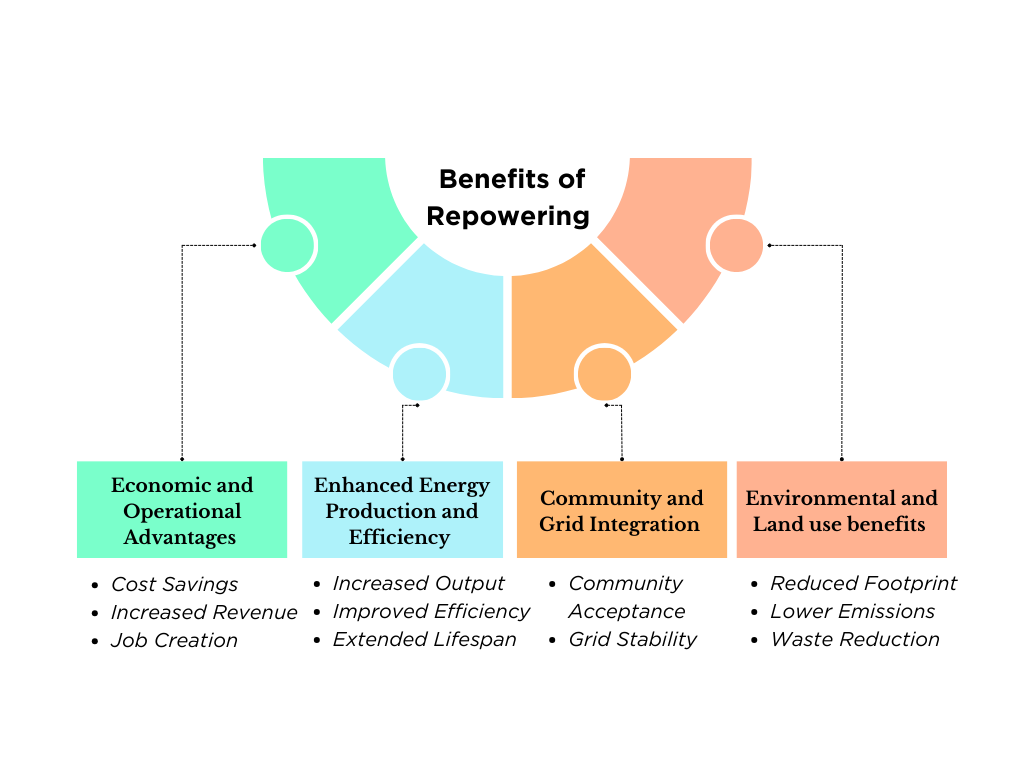
1) Economic and
Operational Advantages
Cost Savings: Utilizing
existing infrastructure, such as grid connections and roads, reduces capital
expenditures compared to building new wind farms.
Increased
Revenue: Higher energy output translates to greater revenue
potential, enhancing the return on investment for wind farm operators.
Job creation: Repowering
projects can stimulate local economies through job creation in manufacturing,
construction, and maintenance.
2) Enhanced Energy
Production and Efficiency
Increased
Output: Repowering enhances the overall energy production of wind farms by
replacing aging turbines with more efficient, higher-capacity models that
maximize power generation from the same site.
Improved
efficiency: New turbines capture more wind energy with fewer
rotations, reducing mechanical stress and maintenance needs.
Extended
lifespan: Repowering extends the operational life of wind farms,
ensuring continued energy production without the need for entirely new sites.
3) Community and
Grid Integration
Community
Acceptance: Upgrading existing sites often faces less public
opposition than new developments, as communities are already accustomed to the
presence of wind farms.
Grid Stability: Modern
turbines are more grid-friendly, offering better integration and contributing
to overall grid reliability.
4) Environmental
and Land use benefits
Reduced
Footprint: Fewer, more powerful turbines mean less land is needed,
minimizing habitat disruption and visual impact.
Lower
emissions: Upgraded turbines produce more clean energy, aiding in
decarbonization efforts and reducing reliance on fossil fuels.
Waste
reduction: Repowering often involves recycling or repurposing
components, decreasing the environmental impact associated with
decommissioning.
Global Trends in
Repowering
Europe:
According to
Iberdrola, fewer than 200 wind farms have been repowered across Europe to date,
with more than half of these projects located in Germany. Data from the
End-of-Life Issues and Strategies Seminar (EoLIS)
2022, organized by WindEurope, shows that on average repowering reduces the number of
turbines in a wind farm by a quarter while increasing the farm’s installed
capacity by a factor of 2.7 and tripling its electricity output. Despite these
significant benefits, the overall adoption of repowering in Europe remains
limited. Currently, less than 10% of wind turbines reaching the end of their
operational life are repowered, largely due to slow and complex authorization
processes.
USA:
Approximately 70
gigawatts (GW) of onshore wind capacity in the United States have undergone
full repowering to date, with an additional 12 GW partially repowered according
to Wood Mackenzie. This
shift underscores the growing recognition of repowering as a viable means to
improve renewable energy output.
India:
The National
Repowering and Life Extension Policy for Wind Power Projects – 2023,
introduced by the Ministry of New and Renewable Energy (MNRE), aims to
modernize India’s aging wind energy infrastructure by allowing the repowering
or refurbishment of wind turbines even before the end of their design life.
This includes upgrading components such as blades, gearbox, generator, and
controller to enhance efficiency and energy output. The policy targets turbines
below 2 MW capacity or those that are outdated or nearing end-of-life,
encouraging both standalone and aggregation-based projects. It offers financial incentives through
institutions like IREDA and facilitates continued or surplus power sale via
flexible Power Purchase Agreements (PPAs). A moratorium of up to two years is
allowed during repowering, and repowered turbines can have an operational life
extended up to 40 years. With a potential to modernize over 25 GW of capacity especially
in states like Tamil Nadu, Gujarat, and Maharashtra, the policy plays a crucial
role in maximizing resource utilization and accelerating India's clean energy
transition.
Challenges in
Repowering
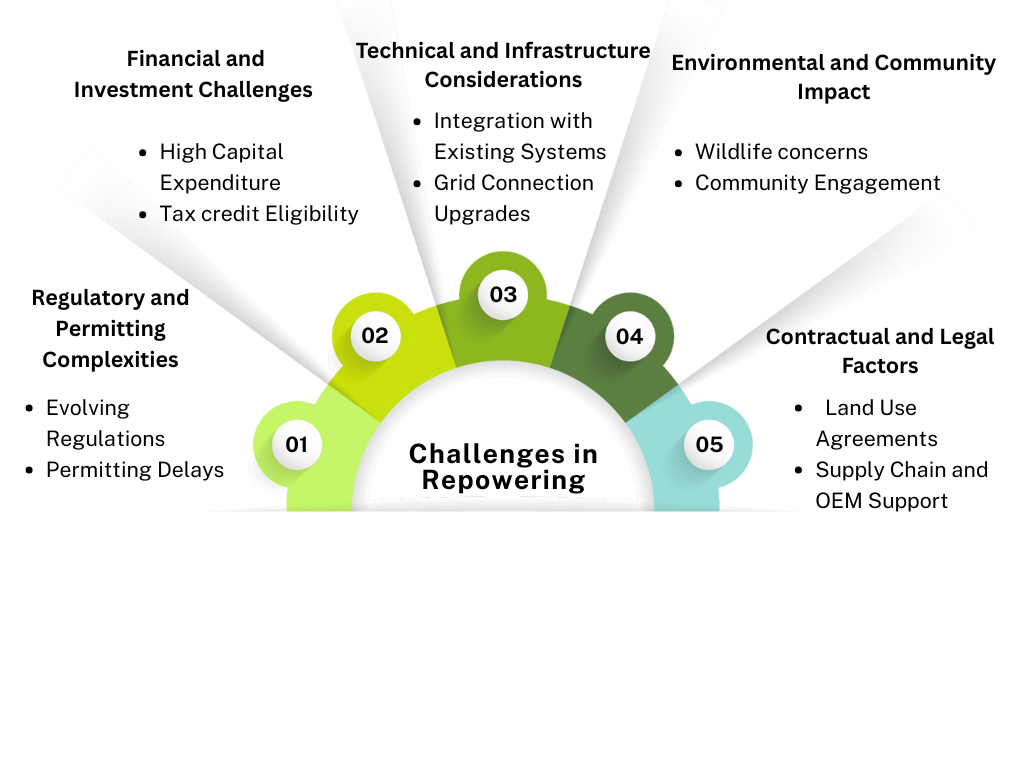
1) Regulatory and
Permitting Complexities
Evolving
Regulations: Changes in local and national laws can impact repowering
projects. For instance, projects developed decades ago may now face new zoning
laws or environmental regulations that affect turbine height approvals and land
use.
Permitting
Delays: Navigating a complex web of permits and environmental
assessments can lead to significant project delays. Proactive engagement with
regulatory bodies and thorough environmental impact studies are essential to
mitigate these challenges.
2) Financial and
Investment Challenges
High Capital
Expenditure: Securing funding for repowering can be difficult,
especially for older projects with limited profit margins. Innovative financing
strategies, such as green bonds or public-private partnerships, may be
necessary to attract investment.
Tax Credit
Eligibility: Repowering projects often face financial challenges due
to strict tax credit or subsidy criteria that require a majority of the
equipment to be new. This limits the reuse of existing components, and if
eligibility thresholds aren’t met, projects risk losing access to key financial
incentives.
3) Technical and
Infrastructure Considerations
Integration
with Existing Systems: Incorporating new technology into existing
infrastructure can present compatibility issues. Careful planning is required
to ensure that new turbines and components integrate seamlessly with legacy
systems.
Grid Connection
Upgrades: Larger, more powerful turbines may necessitate upgrades
to grid connections and substations. In some regions, repowering projects may
face delays due to grid capacity constraints and interconnection challenges.
4) Environmental
and Community Impact
Wildlife
Concerns: Taller turbines with larger blades can pose increased
risks to birds and bats. Environmental assessments and mitigation strategies
are crucial to address these concerns.
Community
Engagement: Effective communication with local communities is vital
to address concerns about noise, aesthetics, and land use. Building trust
through transparency and community involvement can facilitate smoother project
implementation.
5) Contractual and
Legal Factors
Land Use
Agreements: Existing contracts may have clauses that restrict
modifications or expansions, such as limitations on turbine height or road
alterations. Reviewing and potentially renegotiating these agreements is
necessary before proceeding with repowering.
Supply Chain
and OEM Support: Challenges with the supply chain and original equipment
manufacturers (OEMs), including volatile pricing and availability of
components, can impact project timelines and costs.
Repowering presents a
compelling strategy to enhance wind energy output, extend project life, and
accelerate decarbonization goals. Globally, repowering efforts have already
begun to reshape aging fleets. For instance, IRENA highlights that repowered
projects in Europe have reduced turbine counts by up to 25% while tripling
energy output per site. In India, the Global Wind Energy Council (GWEC) reports
that repowering ageing turbines in Tamil Nadu, Maharashtra and Gujarat could
unlock additional capacity without requiring new land acquisition.
Despite regulatory,
technical, and financial hurdles, the potential return on investment remains
high. Estimates show that properly repowered assets can generate more revenue
over their extended lifetime when compared to continued operation of outdated
infrastructure.
As nations aim to
triple renewable energy capacity by 2030, repowering is no longer an option
rather it is a necessary step to optimize the existing wind asset base and meet
the demands of a net-zero future.
At the heart of every
successful repowering project lies not only cutting-edge turbine technology but
also a robust foundation and structural system capable of supporting
next-generation turbines. This is where NeXHS
plays a pivotal role.
With its deep expertise in
wind turbine foundation and structural engineering, NeXHS
ensures that repowering and retrofitting projects are executed with precision,
safety, and efficiency. From structural assessments of aging foundations to
innovative retrofitting designs that accommodate taller towers and
higher-capacity turbines, NeXHS provides end-to-end
solutions that maximize the value of existing sites while meeting evolving
technical and regulatory requirements.
As the global focus shifts
toward optimizing existing assets and accelerating clean energy goals, NeXHS stands ready to support project developers,
IPPs, and utilities in making their repowering and retrofitting journeys
structurally sound, cost-effective, and future-ready.