Sustainable Transport in India: Pathways to a Cleaner, Smarter, and Future-Ready Mobility System
Published on June 11, 2025
Sustainable Transport in
India: Pathways to a Cleaner, Smarter, and Future-Ready Mobility System
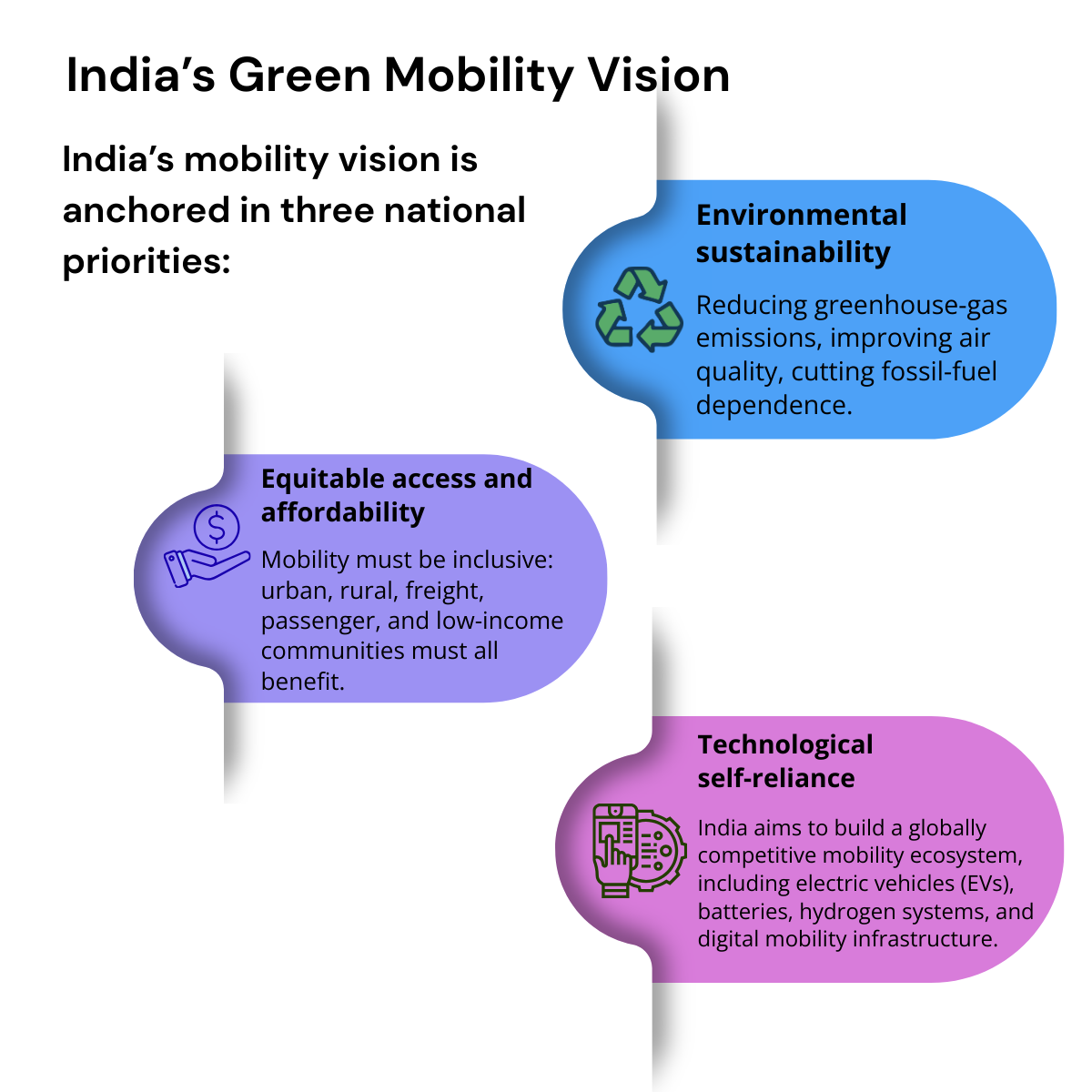
India is undergoing a historic transformation in the way people and goods move. With rising urbanisation, increasing freight demand, growing environmental concerns, and the need for energy independence, the country is shifting decisively towards sustainable transport. This transformation is shaped by a broad policy ecosystem, including India’s green mobility vision, the PM E-Drive Scheme, the FAME Scheme, Bharatmala Pariyojana, the 7C mobility agenda, and national missions on biofuels and green hydrogen.
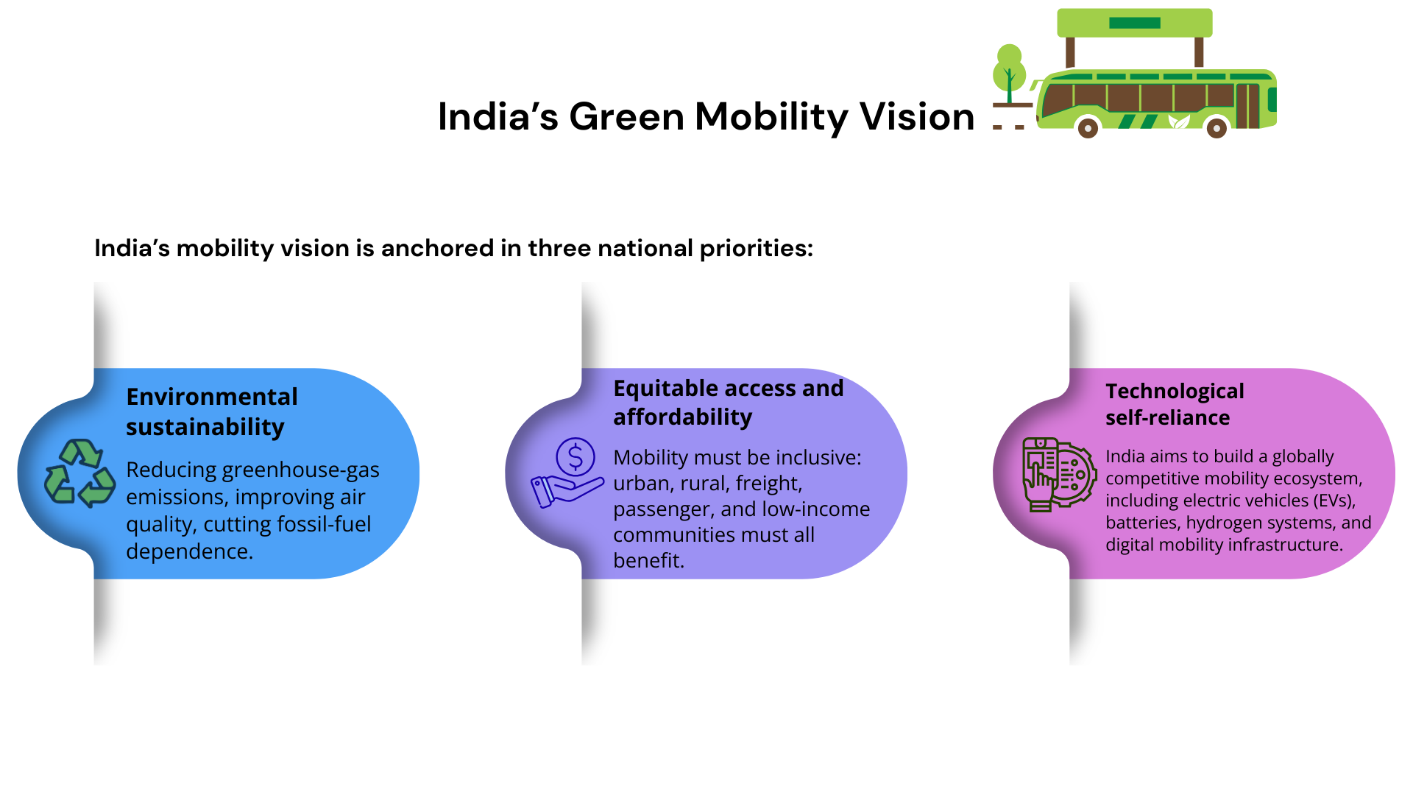
The vision pushes for multimodal (integrating roads, rail, metro, waterways) and multifuel (electric, ethanol, biofuel, hydrogen, hybrid) pathways recognising that no single technology can serve a nation as diverse as India.
2. PM E-Drive Scheme
The PM E-Drive Scheme is the Government of India’s latest nationwide push to accelerate electric mobility.
Its objectives include:
- Incentives for EV adoption across segments
- Charging and battery-swapping infrastructure development
- Electrification of public and shared transport
- Skill development and awareness campaigns
- Industry partnerships for localisation of EV components
This scheme also lays the foundation for India’s emerging clean-freight ecosystem, including electric trucks, which are receiving policy support for the first time.
3. The FAME Scheme – Faster Adoption and Manufacturing of EVs
A major part of India’s sustainable mobility journey is the FAME Scheme (FAME I and FAME II).
This scheme has:
Accelerated EV adoption
- Supported electric two-wheelers, three-wheelers, e-rickshaws, e-autos, e-cars and especially electric buses.
- Boosted EV sales which touched nearly 1.9 million units in 2024 (7.5 % penetration).
Boosted public transport
electrification
- Thousands of e-buses deployed in multiple cities.
- City-level pilots integrating metro, bus, and e-auto.
Strengthened charging
ecosystem
- Grants for public charging stations
- Support for battery swapping
- Incentives for charging infra along highways and logistics corridors
Improved localisation of EV
manufacturing
- Encouraged domestic production of motors, controllers, batteries, and power electronics.
- Supporting India’s ambition to become a global EV manufacturing hub.
Together, PM E-Drive and FAME Scheme form the most powerful EV-centric policy push India has ever executed.
4. Bharatmala Pariyojana
While EVs and fuels matter, sustainable mobility also needs modern infrastructure.
The Bharatmala Pariyojana, one of India’s most ambitious road-infrastructure programmes, aims to:
- Expand and modernise the national highway network
- Reduce transportation time and logistics cost
- Improve freight efficiency
- Create multimodal logistics hubs
- Support e-mobility along highways
Key achievements include:
- High-speed corridors increased from 93 km in 2014 to 2,474 km by 2024
- National highways expanded far beyond the 2014 baseline of 91,287 km
- Integration of EV charging and hydrogen refuelling zones along major corridors
By enabling faster, smoother logistics, Bharatmala supports lower emissions and more energy-efficient transport.
5. The 7C Framework: India’s Guiding Principles for Mobility
India’s green mobility vision is summarised through the 7C mobility framework. The 7C model ensures mobility is not only environmentally progressive but also socially and economically inclusive. Read more about the 7C Framework here.
6. National Policy on Biofuels & National Green Hydrogen Mission
India recognises that EVs alone cannot meet the country’s diverse mobility needs. Hence the shift towards a multifuel strategy.
National Policy on Biofuels
This policy supports alternative fuels that can be used in existing vehicles without major changes.
Key goals:
- 20% ethanol blending (E20) by 2025-26, achieved ahead of schedule in several states
- 5% biodiesel blending by 2030
- Support for agricultural supply chains
- Lower carbon intensity transport for millions of ICE vehicles
Biofuels are crucial for rural mobility, freight, and the large existing vehicle fleet.
National Green Hydrogen Mission
Hydrogen is the future for long-haul, heavy-duty, and high-energy mobility.
Mission targets include:
- 5 million metric tons of green hydrogen per year by 2030
- 60–100 GW electrolyser capacity
- Investments of ₹8 trillion
- Hydrogen truck and bus pilots across key freight corridors
- Hydrogen refuelling infrastructure development
Hydrogen mobility is expected to play a major role in decarbonising India’s freight and industrial transport.
7. Latest Trends in Sustainable Transport in India (2024–2025)
India’s journey towards sustainable transport is moving in the right direction, supported by strong policy frameworks, expanding infrastructure, and growing adoption of cleaner technologies. Schemes like PM E-Drive, FAME, Bharatmala, the Biofuel Policy, and the Green Hydrogen Mission have created a foundation for progress. However, policies alone cannot guarantee success.
While these initiatives offer clear advantages such as reduced emissions, better connectivity, and a push for clean mobility, India still faces significant challenges. Charging infrastructure remains inconsistent across states, EV affordability is still limited for many households, hydrogen and biofuel ecosystems are in their early stages, and urban planning often struggles to keep pace with rapid growth. There is also a gap in public awareness, behavioural change, and individual responsibility when it comes to choosing sustainable transport options.
In reality, achieving true sustainable mobility requires both system-level reliability and personal commitment. Governments, industries, and communities must work together, not only to implement new technologies but also to build trust, promote awareness, and ensure that solutions are practical, inclusive, and affordable. Only when policy, infrastructure, innovation, and public participation align will India be able to move confidently towards a cleaner, smarter, and more sustainable transport future.