Union Budget 2026-27 Gives a Major Push to CCUS?
Published on February 2, 2026
Union Budget 2026-27 Gives a Major Push to
CCUS: Why Carbon Capture Is Critical for India’s Low-Carbon Future
In a strong signal of India’s commitment to balancing
economic growth with climate responsibility, our Country’s Finance Minister
announced an allocation of ₹20,000 crore for Carbon Capture,
Utilisation and Storage (CCUS) in the Union Budget 2026-2027. This
industrial decarbonisation move reflects how India is making major decisive role
about clean energy transition.
With sustainable growth is getting prominent advances
in recent years and urbanization accelerating, carbon emissions from
industry-intensive sectors have risen sharply. These Budget push for CCUS is
hence started to responding to this growing challenge.
What is CCUS?
It is the process of trying to utilise large emission
sources like carbon dioxide (CO₂) from power plants and industrial
facilities with technologies called as CCUS – Carbon Capture, Utilisation
and Storage before it is released into the atmosphere.
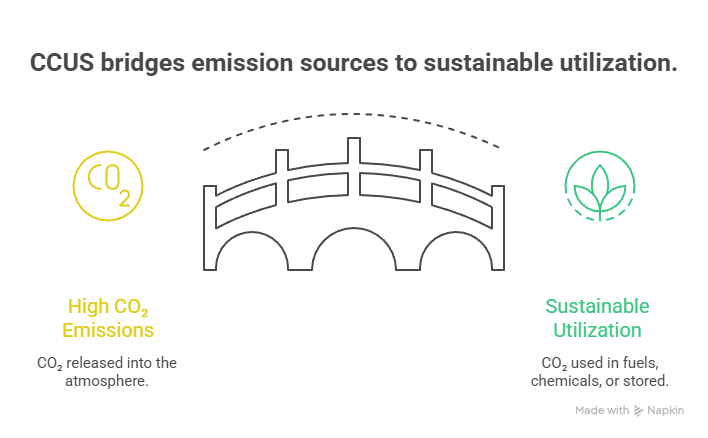
The captured CO₂ can then be used:
- In
fuels, chemicals or in construction materials.
- Stored
in geological formations such as depleted oil and gas fields or deep
saline aquifers.
We can see the appropriate use of CCUS in industries
where the emission of CO₂ be eliminated through renewable energy alone.
Why CCUS Is Critical for India
This CCUS policy has become countries priority due to
India’s emission profile. According to NITI Aayog, industrial sectors
altogether emitted nearly 1,600 million tonnes per annum (mtpa) of Carbon Dioxide in the year 2020. It accounts
for nearly 60-65% of the country’s approx.
And the balance 40% of emissions originates from
agriculture, transport, and buildings—sectors that are not easily amenable
to carbon capture technologies. Thus, industrial sectors results represent the
most practical and scalable opportunity for higher-scale CCUS deployment.
The 2022 NITI Aayog report shows that emissions from
hard-to-abate sectors will rise to almost 2300 mtpa
by 2030 because of economic growth and urban development. The expected rise in
emissions creates an urgent need for early funding of carbon capture and
abatement technology development.
Why CCUS Features Prominently in the Union
Budget
The construction of India's new and modern infrastructure
depends on cement and steel and thermal power and oil and gas and chemical
industries while these sectors produce the highest carbon emissions in the
country. The CCUS allocation of ₹20,000 crore will accomplish the
following goals:
· Enable
emission reduction without disrupting industrial output
· Support
compliance with emerging global carbon regulations
· Encourage
large-scale deployment of clean industrial technologies
· Strengthen
India’s long-term decarbonisation strategy
The government supports CCUS technology to help reduce
emissions which would otherwise be difficult to decrease.
Budget Signals a Broader Clean Energy Push
The CCUS official announcement was part of a wider
clean energy and manufacturing support framework outlined in the Union-Budget.
While presenting these proposals, Nirmala Sitharaman – The Finance
Minister of India, underlined the government’s commitment to multiple
low-carbon technologies.
“To
support nuclear power, I propose to extend the existing customs duty exemptions
on the import of goods required for nuclear power projects till the year 2035.
This exemption will also be expanded to cover all nuclear power plants,
irrespective of their capacity.”
She further stated that measures to strengthen energy
storage and solar manufacturing:
“I
propose to extend the basic customs duty exemption given to capital goods used
for manufacturing lithium-ion cells for battery energy storage systems (BESS).
I also propose to exempt basic customs duty on import of sodium antimonate for
use in the manufacturing of solar glass.”
The combined measures establish a unified policy
framework which implements simultaneous progress for CCUS, nuclear power,
energy storage, and solar manufacturing to establish India's clean energy
ecosystem.
Sectors Expected to Benefit from CCUS
Deployment
This budgetary support for CCUS is expected to unlock
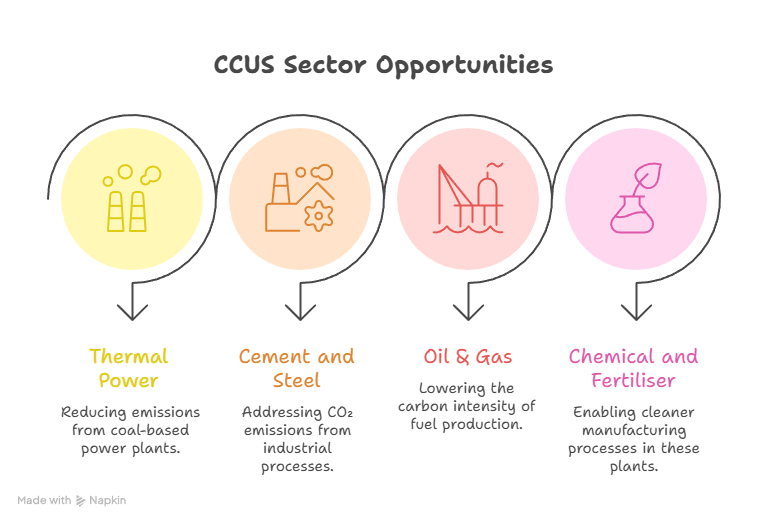
opportunities across multiple sectors:
- Thermal
power plants
– coal-based emission reduction.
- Cement
and steel industries – addressing process-related CO₂ emissions
- Oil
& gas and refineries – lowering carbon intensity of fuel
production
- Chemical
and fertiliser plants –enabling cleaner manufacturing processes.
These sectors are central to India’s economic
development, making CCUS a strategic enabler rather than an optional solution.
What This Means for Industry and
Infrastructure Development
CCUS policy
opens new avenues for:
- EPC
and Engineering Companies,
- Infrastructures
and Interiors
- Technology
developers,
- PMC
firms
CCUS
projects require strong planning and execution and regulatory coordination from
their initial capture system and transport infrastructure development through
their storage site development and monitoring activities.
India’s long-term vision (Net Zero 2070)
India’s Net Zero 2070 vision and the ₹20,000 crore allocation for CCUS in Budget 2026 signal intent, but intent alone does not translate into impact. While the budget marks an important acknowledgement of hard-to-abate industrial emissions, the real challenge lies far beyond financial allocation. The success of CCUS will depend on how effectively projects are identified, designed, and executed at the grassroots level, across power plants, steel mills, cement units, and refineries where emissions actually occur.
Without strong regulatory frameworks, transparent pilot evaluations, skilled manpower, and region-specific deployment strategies, CCUS risks remaining a policy headline rather than a climate solution. Public funding must be matched with accountability, clear timelines, and measurable outcomes, not just large numbers in budget documents. Carbon capture can play a transitional role in India’s climate journey, but only if it is treated as a tool for genuine emissions reduction, not as a shield to delay deeper structural reforms.
If India is serious about sustainable industrial growth, the focus must now shift from allocation to action, from central announcements to site-level implementation, and from optimism to evidence-based progress. Climate action demands persistence, scrutiny, and uncomfortable questions, not applause.