Understanding Cloud Seeding
Published on December 25, 2024
Understanding Cloud
Seeding
Cloud seeding is a form of weather modification aimed at
enhancing precipitation, rain or snow by introducing substances into clouds
that act as condensation or ice nuclei. Core agents include:
- Silver iodide (AgI) – forms ice crystals in supercooled
clouds, mimicking natural ice nuclei.
- Potassium iodide, dry ice (solid CO₂), and liquid
propane – each inducing freezing or condensation under different cloud
conditions.
- Hygroscopic salts (e.g., sodium or potassium chloride) –
attract water vapor and encourage droplet coalescence in warmer clouds.
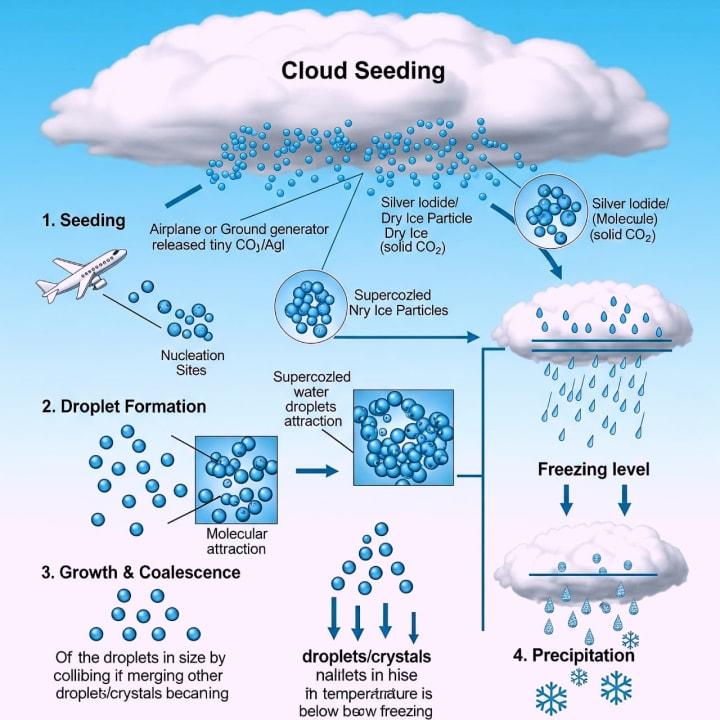
Source: Cloud Seeding: Engineering Rainfall in a Thirsty World
Techniques include:
- Static seeding – dispersing ice-forming nuclei into
supercooled clouds.
- Dynamic seeding – enhancing cloud updrafts to increase
moisture uptake.
- Hygroscopic seeding – using salts to grow droplets in
lower-temperature clouds.
Despite decades of
use, the effectiveness of cloud seeding remains mixed: studies indicate
increases of 5–30% precipitation, varying by region and weather
conditions.
Cloud Seeding in
India: History & Current Status
India has trialed cloud seeding sporadically:
- Tamil Nadu (1983–87, 1993–94) during drought
periods.
- Karnataka (2003–04), and Maharashtra via private
contractor (2004).
- Recent Delhi initiative
(July–August 2025) aimed to address severe air pollution, with potential
rescheduling due to ongoing monsoon rain.
The Delhi project,
costing ₹3.21 crore and to be carried out via Cessna aircraft loaded with
silver iodide and salts, will cover areas such as Rohini, Bawana, Alipur, and
Burari. The India Meteorological Department (IMD), IIT Kanpur, IITM
Pune, and the DGCA are involved, with essential safety and
environmental protocols in place, including post-seeding water quality testing.
Advantages of Cloud
Seeding
- Boosting Water Resources
- Used to increase rainfall/snowpack during
droughts and to support agriculture, reservoirs, and hydropower.
- Examples:
- U.S. Rocky Mountains: “substantial snowfall” filling 50
Olympic pools over 7 500 km².
- Utah: cost-effective – adds acre-foot water for under $3 compared to
$3 000+ via
desalination.
- California: 10–15% increase in snowpack; Nevada
DRI: ~10% seasonal increase.
- Agricultural Enhancement
- North Dakota program increased
precipitation, yielding greater crop returns (benefit: $12–21 per acre
vs. cost $0.40 per acre).
- Drought and Hail Mitigation
- Reduces drought impacts and potential
hail damage.
- Indonesia (2020) cloud seeding led to 79%
more rainfall during a 4-month campaign.
- Texas and North Dakota programs similarly
showed increased crop protection and water supply.
- Air Quality Improvement
- Delhi’s trials aim to wash out
particulate matter from the atmosphere.
- Fire Risk Reduction
- Higher moisture dampens wildfire
conditions.
Disadvantages and
Environmental Concerns
- Effectiveness Debate
- 2003 U.S. NAS: inconclusive evidence.
- Some studies suggest only a 3% increase
in snowpack; results vary greatly.
- Environmental Risks
- Silver iodide toxicity: Though in tiny quantities, concerns
exist about ecological and health impacts .
- Chronic exposure may cause soil or
vegetation accumulation; rare cases of 'iodism' in humans.
- Unequal Water Distribution
- Seeding clouds in one area may reduce
precipitation downwind ("stealing rain").
- Overconfidence Risk
- Can obscure systemic water management
issues; examples: environmental justice concerns in Pakistan and North
Dakota.
- Extreme Weather Misattribution
- Dubai’s floods prompted speculation but
were primarily caused by climate change and poor infrastructure.
Environmental Safeguards and Baselines
Agencies conducting
cloud seeding maintain environmental baselines and protocols:
- Pre- and post-seeding sampling of water, soil, and air for residual
seeding agents.
- Monitoring for heavy metals and chemicals
to ensure concentrations remain within safe limits.
- Regulatory bodies like the DGCA and
IMD in India oversee flight safety and meteorological conditions.
- International programs continually
reassess ecological impacts, maintaining that seeding-triggered silver
deposit often remains below natural background levels .
Global Experiences:
Case Studies
- United States
- Project Stormfury (1962–83): Attempted hurricane
modification using AgI – later discontinued due
to limited cloud ice and natural variability en.wikipedia.org.
- Colorado, Wyoming, California: varied
cloud-seeding success (3–15% precipitation gain) wsj.com.
- UAE
- A robust national program using aircraft
and drones with both hygroscopic salts and AgI,
recording 10–35% rainfall improvement.
- While floods in April 2024 were blamed by
some, scientific consensus attributes them to climate change rather than
seeding.
- China
- Major campaigns before Beijing Olympics
and events; claims up to 2⁄3 reduction in PM2.5 via induced rain.
- Ongoing legal disputes between provinces
over water redistribution.
- Israel
- 2014–21 experimental seeding in the north
was halted due to cost and inconclusive data.
- Pakistan, Indonesia – successful operations targeting smog and
drought, respectively.
Delhi’s Postponed
Cloud Seeding Initiative
Delhi’s pioneering
attempt in July 2025 aimed to pilot
cloud seeding for pollution mitigation. However, ongoing monsoon rains
led to its postponement to 30 August–10 September, better aligned with
weather patterns. The involvement of multiple scientific bodies and
environmental safeguards signals serious governance and intent.
Summary Table: Key
Facts
|
Topic |
Details |
|
Primary Agents |
Silver iodide,
potassium iodide, dry ice, salts |
|
Effectiveness |
5–30% precipitation
increase in some programs |
|
Indian Trials |
Tamil Nadu,
Karnataka, Maharashtra, Delhi (pilot 2025) |
|
Global Examples |
USA, UAE, China,
Israel, Indonesia, Pakistan |
|
Risks |
Toxicity, rain
redistribution, limited efficacy, false expectations |
|
Environmental
Checks |
Baseline testing,
regulatory oversight, public health monitoring |
Cloud seeding is an
innovative tool with targeted benefits in drought relief, water management,
agriculture, and air quality, especially under budget constraints. However,
it comes with uncertain effectiveness, ecological concerns, and ethical
debates around fair water access.
India’s renewed
interest exemplified by Delhi's initiative reflects both desperation amid
pollution crises and advances in weather science. Whether the
technology proves instrumental or symbolic will depend on transparent data,
comprehensive environmental assessments, and balanced governance.
As environmental
challenges intensify, cloud seeding may serve as a bridge solution, but
it must be complemented by long-term climate adaptation, water
conservation, and pollution control strategies.