From Wheels to Watts: Technology for a Zero-Emission Future
Published on July 25, 2024
“The Ministry of Heavy Industries allocated the FAME Scheme (Phase II)
an additional 1,500 crores in February 2024.
India has plans to set up over 22,000 EV charging stations across fuel
stations by 2024”.
Reducing emissions from the transportation sector, a significant
contributor to urban pollution and greenhouse gases, is crucial for
environmental health. The transition to electric vehicles (EVs) and other
alternative fuel vehicles aims to achieve zero or low carbon emissions. This
shift not only focuses on cleaner energy sources but also emphasizes the
development of affordable, accessible, and safe mobility solutions, marking a
significant step towards sustainable urban transportation.
Explore the transformation of the transportation sector with electric
vehicles which is an essential stride towards a cleaner, zero-emission future.
Electric Mobility Initiatives:
Electric mobility is gaining momentum in India as a sustainable solution
to environmental and economic challenges. The transportation sector being
India’s third largest emitter, a shift towards electric vehicles (EVs) aims to
reduce the country's reliance on oil imports, cut CO2 emissions and
address serious health risks associated with air pollution.
India has implemented policies like the Faster Adoption and
Manufacturing of Hybrid and Electric Vehicles (FAME) scheme and Production
Linked Incentive (PLI) scheme to support this transition, encouraging
domestic manufacturing and adoption of EVs, particularly in the public and
private transport sectors. States have also drafted specific EV policies, and
advancements such as falling battery costs and a battery swapping policy are
making EVs more viable.
Challenges:
·
EVs require a higher initial investment compared to internal combustion
engines, which can dissuade buyers.
·
The lack of extensive charging infrastructure and the consequent
"range anxiety" are significant hurdles. Range anxiety is frequently
mentioned as an obstacle to the broader adoption of electric vehicles.
·
Additionally, the electric grid needs substantial upgrades to handle the
increased load from EVs.
While the momentum towards electric mobility is positive, addressing
these challenges is crucial for India to fully leverage the environmental and
economic benefits of EVs.
Policies and incentives to promote EV adoption:
India's vision for future mobility is articulated around the seven
principles known as the 7C's:
Common, Connected, Convenient, Congestion-free, Charged, Clean, and
Cutting-edge.
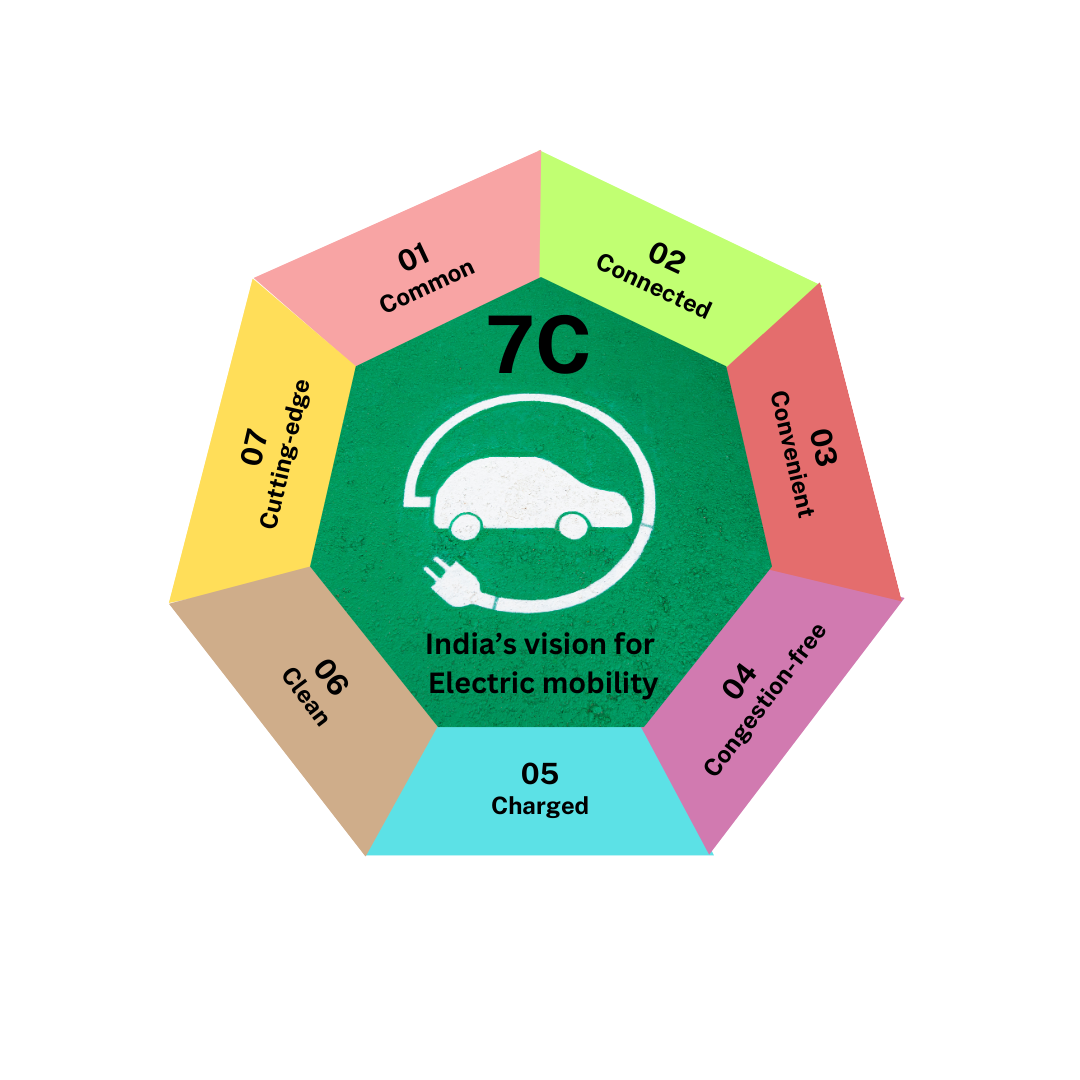
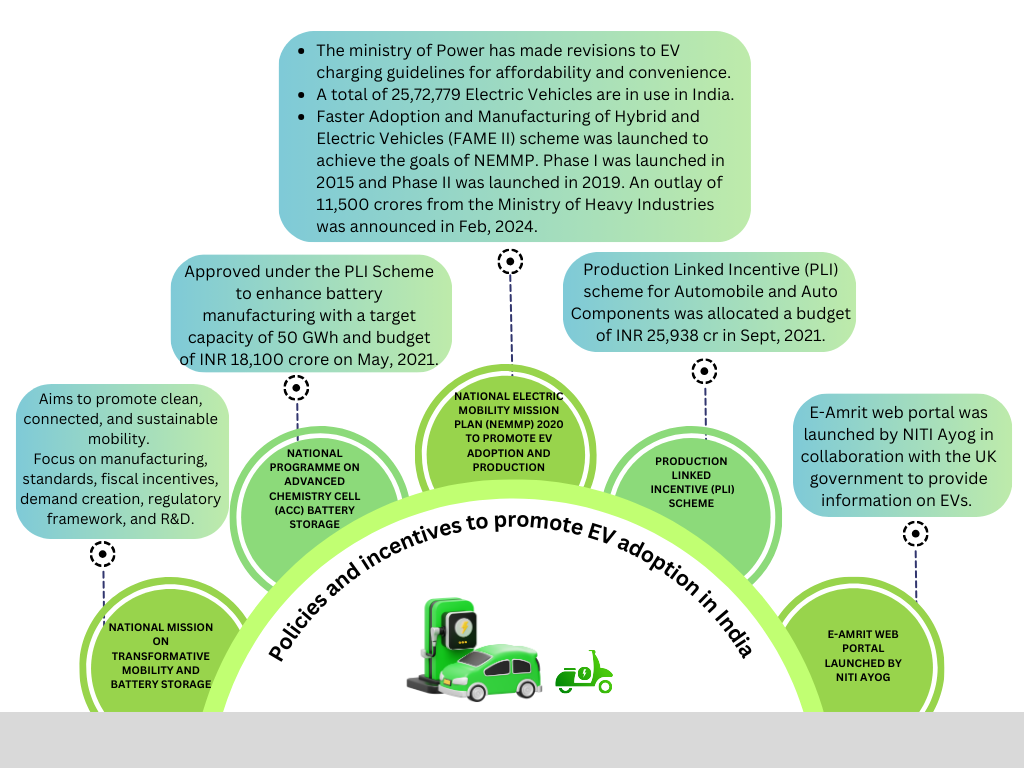
To advance the vision of 7C, the National Mission on Transformative
Mobility and Battery Storage was established, targeting a comprehensive
policy framework that promotes clean, sustainable mobility across the country. The
National Program on Advanced Chemistry Cell (ACC) Battery Storage under the
PLI Scheme, aiming for a 50 GWh manufacturing capacity with an INR
18,100 crores budget was announced in May 2021. The PLI scheme for
Automobile and Auto Components, with an INR 25,938 crores outlay was
announced to further support EV adoption in September 2021. This program has
selected four companies for incentives to boost local battery production.
The Ministry of Power has revised guidelines to make EV charging more
affordable and accessible, allowing EV owners to use existing electricity
connections for charging at home or work. The FAME Scheme Phase II was
allocated an additional INR 1,500 crores to an earlier budget of INR
10,000 crores in 2019 by the Ministry of Heavy Industries in February
2024. As of now, India has 25,72,779
registered electric vehicles. The National Electric Mobility Mission
Plan (NEMMP) 2020 and the E-Amrit portal by NITI Aayog are other crucial
steps towards enhancing EV adoption and production.
In 2021, the Ministry of Road Transport
and Highways (MoRTH), announced that by 2030, the government aims to
achieve an electric vehicle (EV) sales penetration of 30% for private cars,
70% for commercial vehicles, and 80% for two and three-wheelers.
Care Edge Ratings report a notable shift away from traditional fuel
vehicles, noting that petrol vehicle sales decreased from 86% in 2020 to 76%
in 2023. During the same period, sales of alternative fuel vehicles surged
by 400%. Electric vehicles (EVs) are now known for having the lowest
lifetime costs, closely followed by CNG vehicles. This move towards alternative
fuels is supported by falling battery prices, increasing fuel costs, and
government incentives such as the FAME-II scheme, which recently got a funding
boost of INR 1,500 crore to encourage EV adoption.
By 2030, it is anticipated that fuel demand will decrease as electric
vehicle (EV) technologies stabilize. In response, refiners are planning to
invest in petrochemical integration to adapt to the changing market dynamics.
As of February 2, 2024, 12,146 public EV charging stations are operational across India, according to the Ministry of Power. To further support the growth of electric vehicles, the Indian government has ambitious plans to set up over 22,000 EV charging stations across fuel stations by 2024. This expansion is expected to significantly ease the adoption of EVs by reducing range anxiety among potential users.
On March 15, 2024, the Union Government approved a comprehensive scheme to promote India as a global manufacturing hub for electric vehicles (EVs), highlighting the country's commitment to enhancing its EV manufacturing capabilities. The scheme, which is a significant step under the "Make in India" initiative, is designed to attract investments from reputed global EV manufacturers, boosting local production and incorporating advanced technologies. This policy aims to stimulate investment, foster competition, and encourage economies of scale, which are expected to reduce production costs and advance India's manufacturing agenda.
New energy policies targeting reducing diesel use are focused on the trucking sector. Smaller trucks, which are pivotal in e-commerce and delivery services, are poised to be at the forefront of this transition due to their economic benefits and operational efficiencies.
India remains one of the fastest-growing oil markets worldwide, yet the country's embrace of electric vehicles (EVs) has been slower compared to its European and Asian counterparts. This is changing as recent investments in vehicle production and energy infrastructure begin to make a significant impact. Enhanced by government incentives such as tax breaks, these developments are crucial in fostering a robust EV ecosystem. These efforts are integral to India's broader strategy to shift towards more sustainable energy solutions.