How Indian Homes Can Renovate Sustainably: A Zero-Waste Approach
Published on February 25, 2026
How Indian Homes Can Renovate Sustainably: A
Zero-Waste Approach
“India generates up to 500 million tonnes
of construction waste every year. Less
than 1% of it is recycled”
India is the world's third-largest
construction market and will add 15 sq. km of new built space every
single day until 2050. With urban populations set to double to 800 million by
2050, sustainable renovation isn't a lifestyle choice - it's an urgent national
necessity.
India’s construction waste crisis – the numbers
·
India generates around 500 million
tonnes of construction and demolition waste annually
·
<1% of India’s
construction & demolition (C&D) waste is currently recycled or
recovered.
·
34 operational C&D
recycling plants with 35 more planned.
·
₹362 billion projected value of India’s
C&D waste recycling market by 2033
9-Step Sustainable Renovation Roadmap
|
S.No |
Renovation Action |
What to Do |
Key Insight |
|
1 |
Assess
renovation needs |
Walk
through each room and list flooring, fixtures, cabinets, and doors. Identify
what can be reused, relocated, or replaced |
Up
to 25% of materials from old homes and 75% from newer homes can be
reused in India (TIFAC - Technology
Information, Forecasting and Assessment Council). |
|
2 |
Set
Sustainability Goals |
Define
clear targets such as diverting 80% of demolition waste, using
reclaimed materials, or achieving IGBC/GRIHA certification. |
Only
10–15% of new buildings in India are green-certified (IGBC, 2024). |
|
3 |
Choose
sustainable materials |
Use
materials like fly ash bricks, AAC blocks (Autoclaved Aerated Concrete
Blocks), recycled aggregates, bamboo, lime plaster, and low/zero-VOC finishes |
India’s
green building footprint exceeded 4.53 billion sq
ft in 2023 (IGBC). |
|
4 |
Plan
material use carefully |
Measure
materials accurately and avoid over-ordering, which is a major source of
construction waste. |
Illegal
dumping of construction waste in lakes and wetlands is increasing
(CAG, 2024). |
|
5 |
Create
a realistic budget |
Green
homes may cost upto 15% more initially but can save
20-30% energy and 30-50% water in long run. |
Green-certified
properties can command a 10-15% price premium (JLL India, 2024) |
|
6 |
Hire
eco-conscious professionals |
Work
with contractors familiar with Construction & Demolition Waste
Management Rules and waste segregation practices. |
Proper
waste handling improves recycling and reduces landfill disposal. |
|
7 |
Develop
a waste management plan |
Set
up separate bins for rubble, wood, metal, drywall, and general waste
before demolition begins. |
India
targets 25% C&D waste recycling by 2025–26 and 100% by 2028–29. |
|
8 |
Explore
second-hand and upcycled materials |
Visit
salvage markets for reclaimed doors, tiles, furniture, and fixtures. |
Reclaimed
materials can cost 40–60% less than new materials. |
|
9 |
Plan
for end-of-life reuse |
Select
materials that can be recycled or reused in the future instead of
composites that end up in landfills. |
Supports
circular construction
and long-term resource efficiency. |
Planning Materials the Right Way:
India's construction boom is creating a
waste crisis largely invisible to most homeowners. 150 to 500 million
tonnes of C&D waste are generated annually - and the wide range in
that estimate itself tells a story: most cities don't even track C&D waste
separately from general solid waste.
A large portion of this waste travels
through informal systems - debris contractors who dump it in the nearest empty
plot, wetland, or roadside. When materials arrive mixed and contaminated, they
become unrecyclable, weakening the entire market for recycled construction
materials.
Homeowners who plan quantities carefully and
segregate materials properly can significantly reduce this waste.
Key Practices:
·
Calculate exact material
quantities and avoid ordering more than 10% excess.
·
Confirm supplier return
policies before placing any orders
·
Source materials locally to
reduce embodied transport emissions
·
Use fly ash bricks, AAC
blocks, or recycled aggregates where possible
·
Submit a waste management
plan as required under India’s C&D Waste Management Rules 2025
Composition of India’s
Construction Waste
1. Concrete/brick:
60%
2. Soil
Sand: 18%
3. Wood:
10%
4. Metals:
7%
5. Others:
5%
[All of these have viable recycling
pathways. Delhi, Bengaluru, and Mumbai already convert C&D waste into
recycled aggregates, paver blocks, and kerb stones.]
Think End-of-Life - India's Policy Is Now
Catching Up
Key Policy Milestones:
·
2016 - C&D waste rules
introduced
·
2018 - Rules strengthened
with user charges and recycling mandates
·
2025 - Expanded rules
including EPR certificates and monitoring portal
·
2028 - Target of 100%
recycling for demolition and reconstruction projects.
This means the materials chosen today will
exist within an increasingly regulated recycling ecosystem.
Choosing Materials with a Future
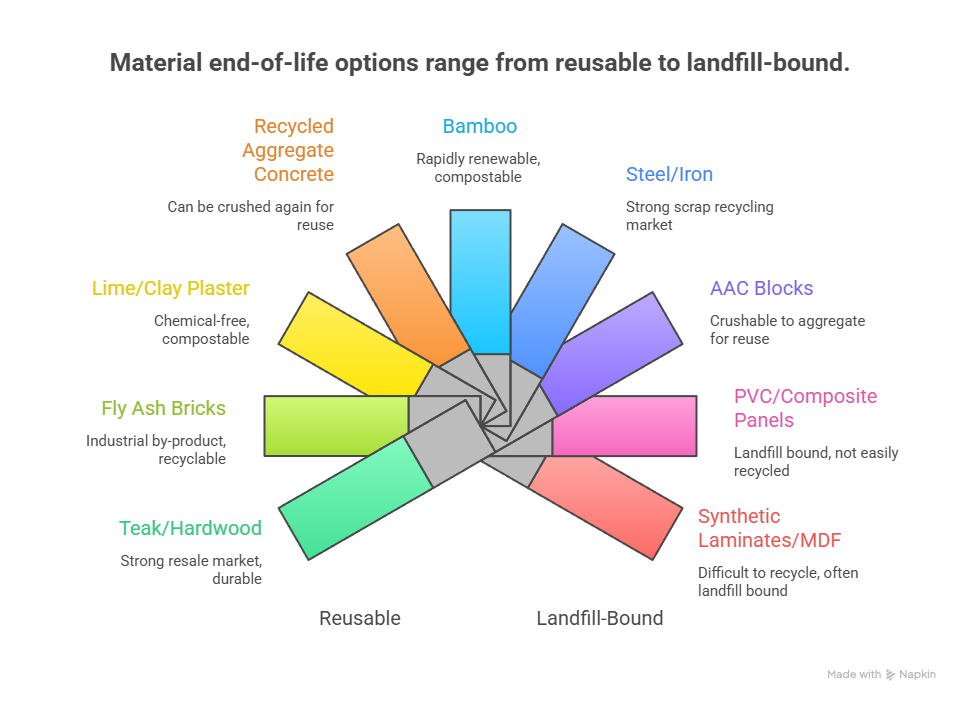
Designing for Natural
Light and Water Efficiency
India’s diverse climate -from Chennai’s humid
heat to Delhi’s extreme summer winter swings- makes passive design strategies
not just environmentally smart but financially essential IGBC data shows green
buildings in India save 30-50% on energy and 30-50% on water compared to
conventional construction.
In 2022 alone, IGBC-certified buildings
across India conserved over 45 billion kWh of energy and 14
billion litres of water while cutting 40 million tonnes of greenhouse
gas emissions. These are not aspirational numbers - they're documented savings
from buildings already standing.
Natural light orientation,
cross-ventilation, jaali screens, deep overhangs, and
rainwater harvesting have been part of Indian vernacular architecture for
centuries. Zero-waste renovation means returning to these principles - updated
with modern materials.
1. Daylight
Design: Proper window orientation can reduce
artificial lighting demand by up to 40%.
2. Rainwater
harvesting: mandatory in many Indian states, A properly
designed rooftop system can meet 30-60% of a home’s water needs.
3. Cross
ventilation: Strategic window placement reduces cooling
load dramatically -especially in south and west Indian’s humid zones.
4. Thermal
Mass: AAC blocks, exposed brick, and stone absorb
heat during the day and release it slowly reducing AC dependence
5. Green
Roofs: Reduce urban heat island effect and improve
insulation – increasingly popular in Bengaluru and Hyderabad renovations.
6. Solar-ready
wiring: wire for rooftop solar during renovation –
retrofitting costs 3x more. Government subsidies are available under MNRE
schemes.
Optimize Indoor Air
quality:
A zero-waste renovation is not only about
waste reduction. It is also about what residents breathe every day. Indoor air
quality is especially critical in India where outdoor pollution levels are
already extremely high.
Healthy renovation practices:
✓Zero-VOC
paints and primers - available from most major Indian brands
✓Natural
adhesives
for flooring instead of solvent-based options
✓Lime wash
or clay plaster on walls - traditional, breathable, and non-toxic
✓Solid teak, rosewood, or mango wood
over MDF or laminate
✓Mechanical ventilation or passive jaali screens for continuous fresh air
India’s Indoor Air Crisis
·
The US EPA estimates indoor air can be
2 to 5 times more polluted than outdoor air.
·
Cities like Delhi, Mumbai, Chennai and
Bengaluru frequently exceed WHO safe limits.
·
Synthetic building materials can
worsen indoor air pollution.
Natural materials such as lime plaster, solid wood, and low VOC finishes
improve indoor air quality significantly.
India’s Green Certification: At a Glance:
1.
IGBC (Indian Green
Building Council) – India’s most widely adopted system,
covers residential, commercial, industrial, and healthcare. Ratings: Certified,
Silver, Gold, Platinum.
2.
GRIHA (Green Rating
for Integrated Habitat Assessment) - India's
national rating system, developed by TERI. Emphasises energy conservation,
sustainable materials, and occupant comfort. Rating: 1–5 Stars.
3.
LEED India
(Leadership in Energy and Environmental Design) - International certification, commonly used for commercial and
Grade A office projects. In 2024, India certified 370 projects covering 8.5
million sq. m to LEED specifications.
4.
BEE Star Rating - Bureau of Energy Efficiency's scheme for energy performance in
commercial buildings and appliances.
Tamil Nadu’s Policy on Construction
Waste
Tamil Nadu is also strengthening its regulatory approach to
construction and demolition (C&D) waste management. Through the Tamil
Nadu Construction and Demolition Waste Management Rules Notification (2025),
the state has outlined procedures for handling, transportation, recycling, and
monitoring of construction debris to reduce illegal dumping and promote
material recovery. These measures aim to improve waste segregation at source,
support recycling infrastructure, and align state practices with India’s expanding
circular construction policies.
To know more about the guidelines: 312_Ex_III_2_2025.pdf
Building a Culture of Zero-Waste
Renovation
India’s zero-waste renovation movement
is still in its early stages, but momentum is growing quickly. Across the
country, architects, contractors, and homeowners are experimenting with better
materials, smarter waste management, and more responsible design practices. The
speed of this transition will depend not only on innovation, but on how openly
knowledge is shared across the renovation ecosystem.
Every renovation project creates an
opportunity to influence others. Sharing your waste diversion rate, discussing
which contractors sorted demolition waste responsibly, or publishing your
material choices can help normalize sustainable renovation practices. When
these decisions become visible, they become replicable. At India’s scale of
construction, even small improvements can compound into significant national
impact.
At IDREA, we believe
sustainable renovation is not only about reducing environmental impact but also
about creating practical frameworks that homeowners, builders, and designers
can realistically adopt. By promoting responsible material choices, waste
management practices, and knowledge sharing, the renovation sector can move
toward a more circular and resource-efficient future.
Zero-waste renovation is not a single
solution or technology. It is a shift in mindset, where every design decision,
material choice, and demolition practice contributes to building a more
sustainable built environment for India.