Beyond Pollution: How India is Fighting to Reclaim Its Rivers
Published on June 16, 2025
Beyond Pollution: How India
is Fighting to Reclaim Its Rivers
India is home to some of
the world's most vital river systems, sustaining nearly 600 million people
and serving as the backbone of agriculture, industry, and biodiversity.
However, decades of pollution, deforestation, industrialization, and
unregulated urban expansion, along with other significant challenges, have put
immense pressure on these rivers. A 2022 report by the Central
Pollution Control Board (CPCB) identified 311 polluted river
stretches across 279 rivers in 30 states and Union Territories.
The Yamuna, Ganges, and Godavari remain among the most severely affected.
Recognizing this crisis,
India has launched extensive river conservation efforts at both governmental
and grassroots levels. From large-scale clean-up initiatives to
community-driven actions, these efforts reflect an urgent need to restore the
nation’s rivers before it is too late.
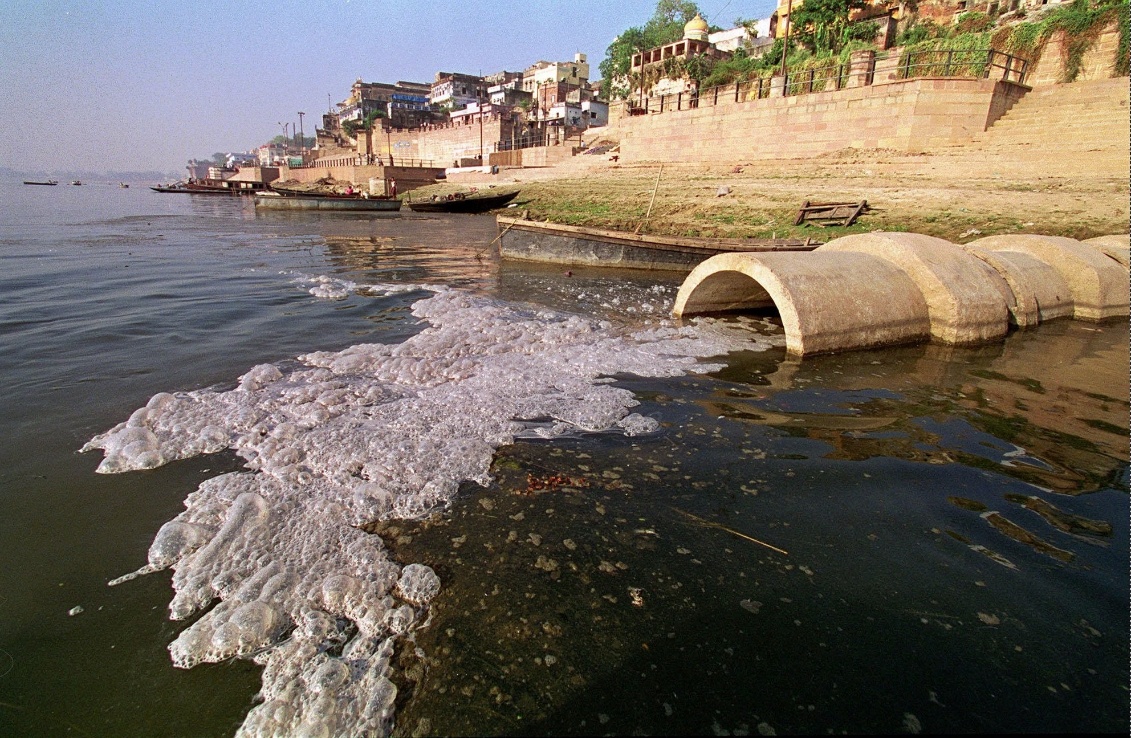
A heavily
polluted stretch of the Ganges River near the Varanasi ghats, where untreated
wastewater is discharged, starkly illustrates the severity of river
contamination across India (Image Courtesy: Telegraph).
Billions Spent, but Is It
Enough?
Namami Gange Program: The
₹20,000 Crore Cleanup Mission
Launched in 2014, the
Namami Gange Programme is one of the world's largest and most ambitious river
restoration initiatives. With a budget of ₹20,000 crore (£2.3
billion), the program aims to clean and rejuvenate the Ganges through
several key measures:
- Sewage Treatment: Over 409 sewage treatment projects have been
initiated, with 185 fully completed as of 2023.
- Biodiversity Conservation: Conservation efforts have led to a revival of
species like the Gangetic dolphin, which was once on the brink of
extinction.
- Afforestation and Erosion Control: More than 13,000 hectares of land have been
afforested to protect riverbanks and replenish groundwater levels.
The results have been
mixed. In some areas, such as Haridwar, Varanasi, and Prayagraj, water
quality has shown significant improvement, with higher dissolved oxygen (DO)
levels and reduced bacterial contamination. However, many sections remain
heavily polluted due to untreated industrial waste and urban sewage discharge,
highlighting that the challenge is far from over.
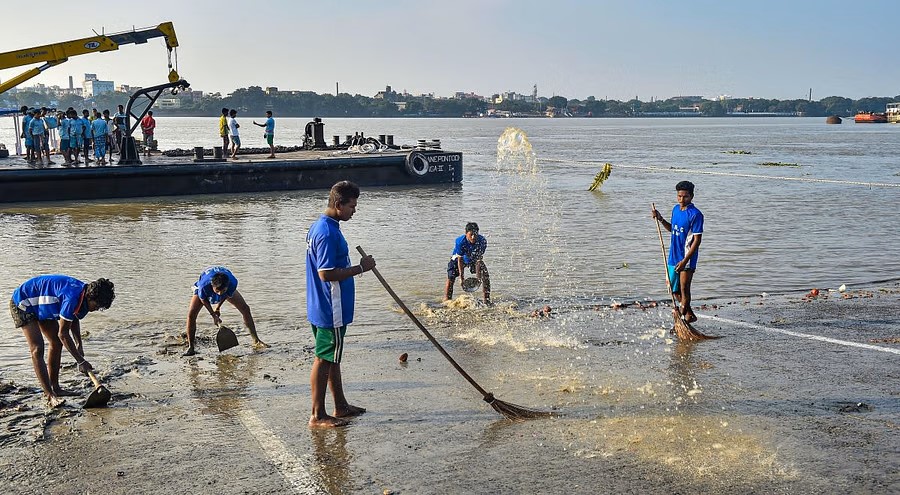
Representative image/Credit: PTI
Photo
The Clean Yamuna Campaign:
A 95% Polluted River
The Yamuna, a crucial water
source for over 20 million people in Delhi, is now one of the most polluted
rivers in India. According to the Central Pollution Control Board (CPCB),
nearly 95% of its pollution originates from Delhi’s urban sewage and
industrial waste. To address this crisis, the Yamuna Action Plan (YAP), a
₹1,500 crore (£150 million) project funded by the Japan International
Cooperation Agency (JICA), was launched to improve wastewater treatment
infrastructure.
Despite these efforts,
large stretches of the Yamuna in Delhi remain unsafe for bathing, with 22
out of 25 monitored locations still heavily polluted. Several recent
initiatives, such as Meri Yamuna, Meri Dilli (2023), have sought
to actively engage local communities, schools, and corporate stakeholders in
cleanup efforts. These initiatives highlight the ongoing need for sustained
public participation in restoring the river.
State-Level River Rejuvenation Projects
Apart from the Ganges and
Yamuna, many state governments have launched their own river revival schemes:
Narmada River Cleaning in Madhya
Pradesh
Under
the National River Conservation Plan
(NRCP) and the Narmada Seva Mission, the Madhya Pradesh government, along
with central support, has implemented multiple initiatives to reduce pollution
in the Narmada River. Efforts include the construction of sewage treatment plants (STPs) in cities like Jabalpur and Hoshangabad, afforestation along riverbanks, and
strict regulations on industrial waste discharge. The Namami Devi Narmade
Yatra, launched by
the state government, promotes community participation in river conservation.
Despite these measures, challenges such as untreated sewage and agricultural
runoff persist, requiring sustained efforts.
Godavari
River Cleaning in Maharashtra
The
Godavari River, often called the "Ganga of the South," is a
crucial water source for Maharashtra. Under the NRCP, the central and state
governments have undertaken sewage management projects, particularly in Nashik
and Nanded, where major pollution originates. The Godavari River Cleaning
Project includes setting up sewage treatment plants (STPs), regulating
industrial effluents, and promoting eco-restoration through afforestation and
riverbank conservation. The Godavari Swachhata
Abhiyan, supported by local authorities and citizen groups, has further
strengthened cleanup efforts. However, increasing urbanization and industrial
waste continue to pose challenges, requiring stricter enforcement and long-term
sustainable solutions.
Cauvery River
Cleaning in Tamil Nadu
Under the National River
Conservation Plan (NRCP), efforts have been made to reduce pollution in the
Cauvery River, which is a vital water source for Karnataka and Tamil Nadu. The
program focuses on sewage treatment, riverbank restoration, and public awareness
campaigns to curb industrial discharge and urban waste. Several sewage
treatment plants (STPs) have been set up in cities like Tiruchirappalli and
Erode, helping to improve water quality. However, continued efforts are
needed to fully restore the river, as pollution from untreated sewage and
industrial effluents remains a challenge.
The Hindon River in Uttar Pradesh
The Hindon River in Uttar Pradesh
has become severely polluted due to unchecked industrial effluents and
inadequate sewage treatment facilities. Originating from the Shivalik Hills in
Saharanpur, the 400-km rain-fed river supports approximately 19 million
people across seven districts. According to a 2023 compliance report by the
Central Pollution Control Board (CPCB), the river receives 72,170.9
kilolitres per day (KLD) of effluents from 357 industries and 943.63
million litres per day (MLD) of domestic sewage. Despite existing
regulations, many industries fail to treat their effluents properly, leading to
elevated levels of heavy metals like lead and chromium in the water. This
contamination has been linked to serious health issues, including a higher incidence
of cancer among local populations.
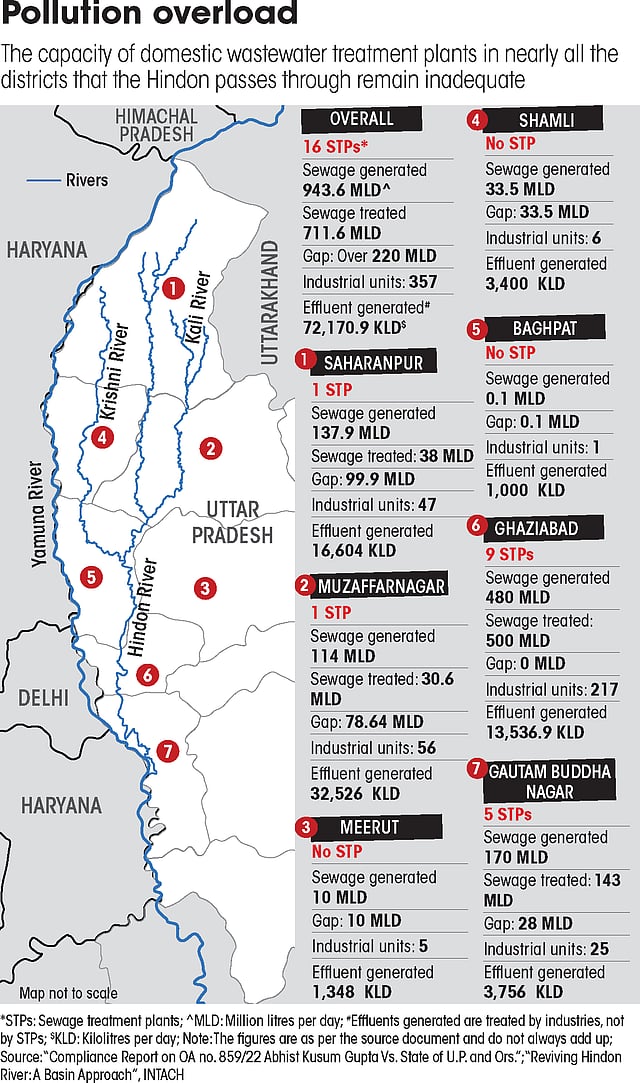
Number of sewage treatment
plants across the Hindon River (Source: DownToEarth)
Citizen-Led Movements: When People Fight for Their Rivers
While government
interventions are critical, some of the most impactful river conservation efforts
throughout India have been driven along by citizens as well as activists. These campaigns have brought ecological problems to the forefront and
also affected many policies and legal rulings.
Narmada Bachao Andolan: A 40-Year Battle for Justice
The Narmada
Bachao Andolan (NBA), mainly spearheaded by MedhaPatkar, is certainly one of the most meaningful ecological campaigns in
India’s history. From the 1980s onwards, it strongly fought against large dam
constructions upon the actual River Narmada, which unfortunately threatened to displace
over 250,000 people.
NBA could not stop all the
dams. It forced the government to introduce stronger rehabilitation policies for displaced communities, and made ecological clearance a critical
step in large-scale infrastructure projects. It's still a prime illustration of how ecological management can be
influenced by public sentiment.
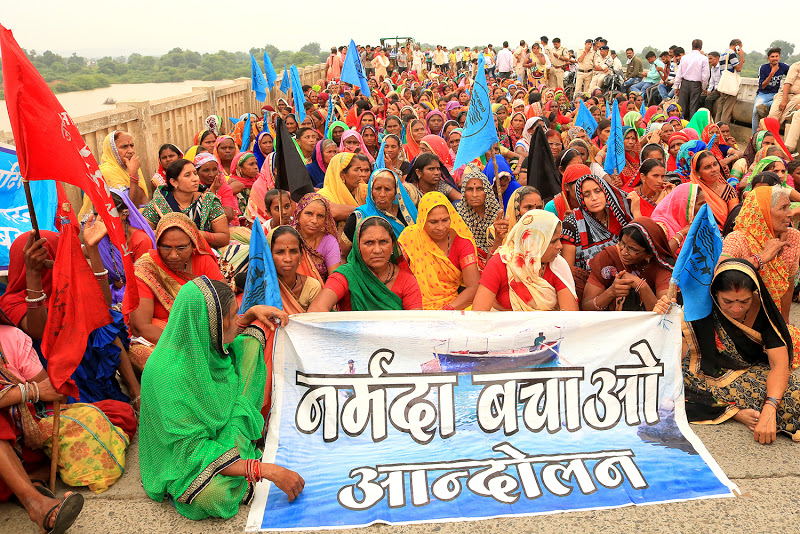
Protesters involved in the
Narmada Bachao Andolan movement advocate against large dams situated upon the
Narmada River, which seriously threaten indigenous communities within that
fragile ecosystem (Image Courtesy: janataweekly)
Save Palar Movement: Tamil Nadu’s Fight Against Industrial Pollution
The Palar
River, formerly a key drinking
water source for well over 3 million people located in Tamil Nadu, suffered large pollution due to effluent released
from over 300 tanneries. A number of farmers,
along with a number of ecological activists, instigated multiple legal
petitions as well as multiple protests. These
actions eventually caused strict government regulations, which enforced Zero Liquid Discharge (ZLD) norms within the region, reducing pollution levels by over 60%.
The Road Ahead: Key Changes Needed
Climate change is further
worsening India’s river crisis, with rising temperatures impacting both water
flow and quality. To ensure effective river conservation, the following
measures are essential:
- Stricter Pollution Regulations: Enforcing stricter policies to prevent
industrial effluents from being discharged into rivers and streams.
- Decentralized Water Treatment: Investing in decentralized sewage treatment
systems to manage urban wastewater more efficiently.
- Sustainable Urban Planning: Implementing policies that protect riverbanks
from encroachment and unregulated real estate development.
- Stronger Local Conservation Efforts: Providing greater financial and technical
support to grassroots river conservation campaigns.
- Technology-Driven Monitoring: Leveraging AI for real-time river monitoring
and using satellite imaging to accurately track pollution levels.
With multiple water crises
speeding up across the globe, the destiny of India’s rivers will ascertain the
future water security, agriculture, and biodiversity within the country. These
aren't simply water bodies, they're flourishing ecosystems, cultural icons, and
economic lifelines, absolutely vital in nature. The moment to act is here right
before our rivers are damaged beyond repair by neglect and by overuse.