The Future of Lithium-Ion Battery Recycling: Challenges & Innovations
Published on July 15, 2025
The Future of Lithium-Ion Battery Recycling:
Challenges & Innovations
Lithium-ion batteries (LIBs) are central to current
energy storage, they power
smartphones and laptops as well as electric vehicles (EVs) and renewable energy
grids. As demand of LIBs rapidly grows at an exponential rate, concerns around
its supply chain sustainability, raw material shortages, and disposal at
end-of-life have substantially increased. The worldwide LIB production is
projected to exceed 2.5 terawatt-hours by 2030. Thus, the need for an
efficient recycling ecosystem is huge (International Energy Agency, 2023).
Even upon recycling's vital importance, present
worldwide actions are not keeping pace with the quick growth from battery use.
Statistics indicate that only about 5% of LIBs undergo recycling across the
globe, but the other portion ends up in landfills, creating serious ecological
risks (CAS, 2023). Dealing with these issues calls for large improvements in
recycling technologies, policy frameworks, along with industry collaboration.
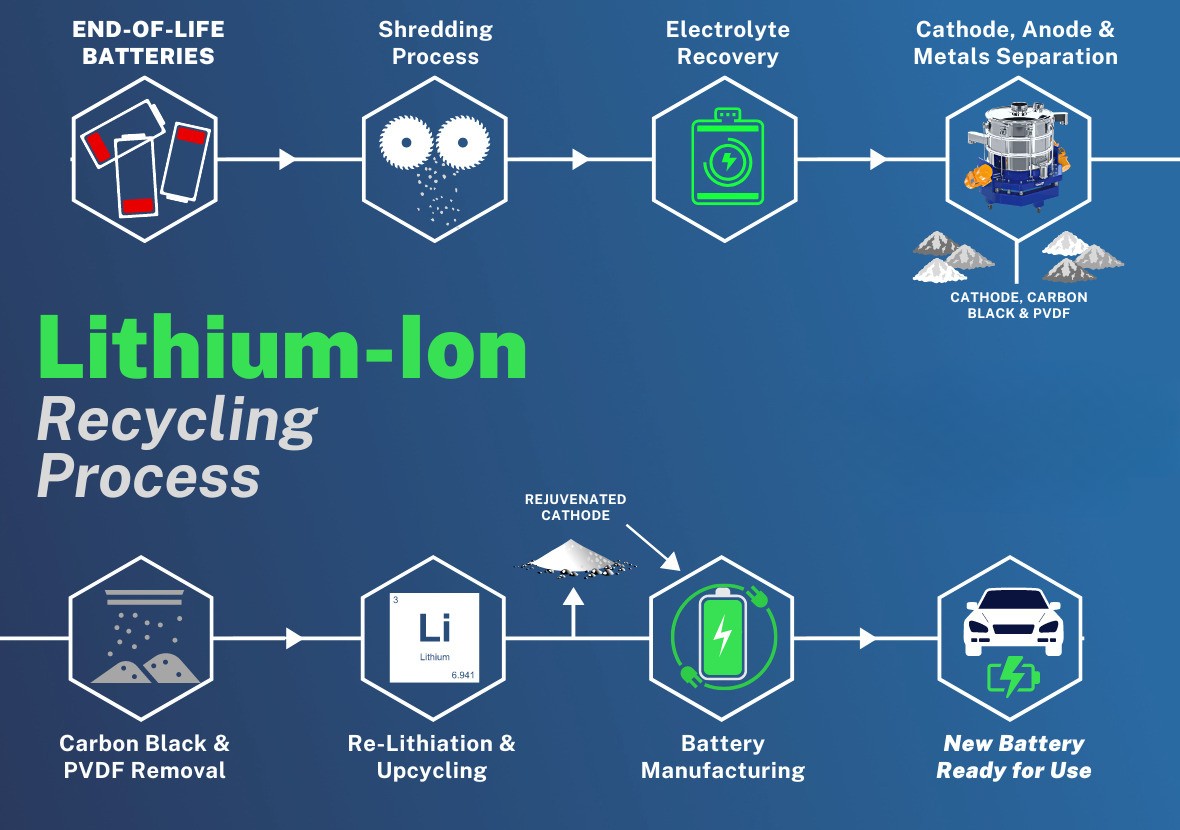
Image
Courtesy: Elcanindustry
Why Is Lithium-Ion Battery Recycling So Important?
The chief rationale to grow LIB reprocessing is to
secure the lively provision of key natural materials such as lithium, cobalt,
nickel, and manganese. The extraction of these resources bears large ecological
and ethical implications. For example, extracting lithium uses a lot of energy
because it requires 2.2 million liters of water
for each ton of lithium made (International Renewable Energy Agency, 2022).
Also, the cobalt mining business has been under
scrutiny because of accounts of underage workers in the Democratic Republic of
Congo and dangerous work environments, which provides almost 70% of the
globe’s cobalt (Amnesty International, 2022). Recycling LIBs can substantially
reduce reliance upon virgin mining, decreasing carbon emissions by
approximately 50% in comparison to new battery production (World
Economic Forum, 2023).
Beyond ecological concerns, battery recycling also
holds large economic potential. According to a report from Fortune Business
Understandings (2023), the North American LIB recycling market alone is
projected to reach $265 million by 2028, driven via increasing demand
for electric vehicles along with stricter government regulations.
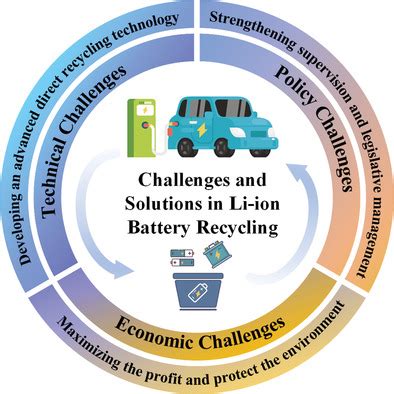
Image
Courtesy: Wiley
Major
Challenges Hindering Lithium-Ion Battery Recycling
Despite
its benefits for the environment, recycling of LIBs encounters some obstacles
in its process that have sustained reduced rates in global recycling.
1.
Technical Challenges in Recycling Processes
A
prominent impediment among them is that LIBs have a complex constitution. In
contrast with lead-acid batteries, with their standardized chemistry, LIBs are
available in multiple chemistries, that include lithium iron phosphate (LFP),
nickel-manganese-cobalt (NMC), as well as lithium cobalt oxide (LCO). Every
chemical composition needs its own method for recycling. It is hard, therefore,
to put into practice one standard recycling procedure (International Renewable
Energy Agency, 2022).
In
addition, the architecture using LIBs renders disassembly difficult. A
collection of batteries gets sealed, glued, or even welded, thereby increasing
the cost as well as the labor needed during
recycling. To make LIB dismantling more efficient, further advanced automation
solutions are in definite need (CAS, 2023).
2.
Economic Viability and Cost Barriers
Getting
lithium, including other useful metals, out of dead batteries is frequently
more costly than extracting fresh raw materials. Currently, the cost of LIB
recycling varies between $1.50 and $2.50 per kilogram, but new material
extraction costs are often lower (International Energy Agency, 2023).
One
major issue is that the technologies used for lithium recovery remain quite
inefficient. Usual pyrometallurgical along with hydrometallurgical methods for
recovery of valuable metals like cobalt and nickel often fail in efficient
extraction of lithium. This leads to further supply shortages (World Economic
Forum, 2023).
3.
Logistical and Safety Challenges
The
collection, transportation, as well as storage for used LIBs pose logistical
challenges. Since lithium-ion batteries have high energy density as well as
possible fire hazards, they are regarded as dangerous refuse. In recent years,
LIBs improperly disposed off have been linked with a
number of recycling plant fires, greatly igniting worries about safety
(Environmental Protection Agency, 2023).
A lot
of users are not aware of correct battery handling. This results in LIBs being
thrown away in dumps instead of specified recycling locations (Amnesty
International, 2022).
Innovations
and Emerging Technologies in LIB Recycling
Recognizing
limitations from customary recycling methods, several technical innovations are
being developed for enhancement of the efficiency along with profitability in
LIB recycling.
1.
Direct Recycling Technologies
Unlike
common approaches, direct recycling fully keeps the battery’s whole cathode
makeup, letting materials be broadly reused without totally reducing them to
separate parts. This specific approach has sufficient potential for decreasing
certain costs by almost 40% in comparison to customary recycling methods
(CAS, 2023).
2. AI
and Robotics in Battery Disassembly
Companies
are developing robotic automation solutions along with the utilization of
artificial intelligence (AI) to sort as well as dismantle batteries
efficiently. This is to address the complexity regarding battery disassembly.
The rates in material recovery can be improved, and labor
costs are reduced using automated processes (World Economic Forum, 2023).
3.
Bacteria-Based Lithium Recovery
One biometallurgy innovation includes using bacteria in the
extraction of lithium and further rare metals out of used LIBs. Early research
suggests that microbial leaching processes can recover over 85% of
lithium, with minimal ecological effect (The Guardian, 2024).
4.
Solid-State Battery Recycling
With
the rise of solid-state batteries (SSBs), researchers are exploring new
recycling techniques tailored for these advanced battery chemistries.
Solid-state batteries contain diminished flammable components in comparison to
customary lithium-ion batteries, making their recycling safer as well as more
energy-efficient (Environmental Protection Agency, 2023).
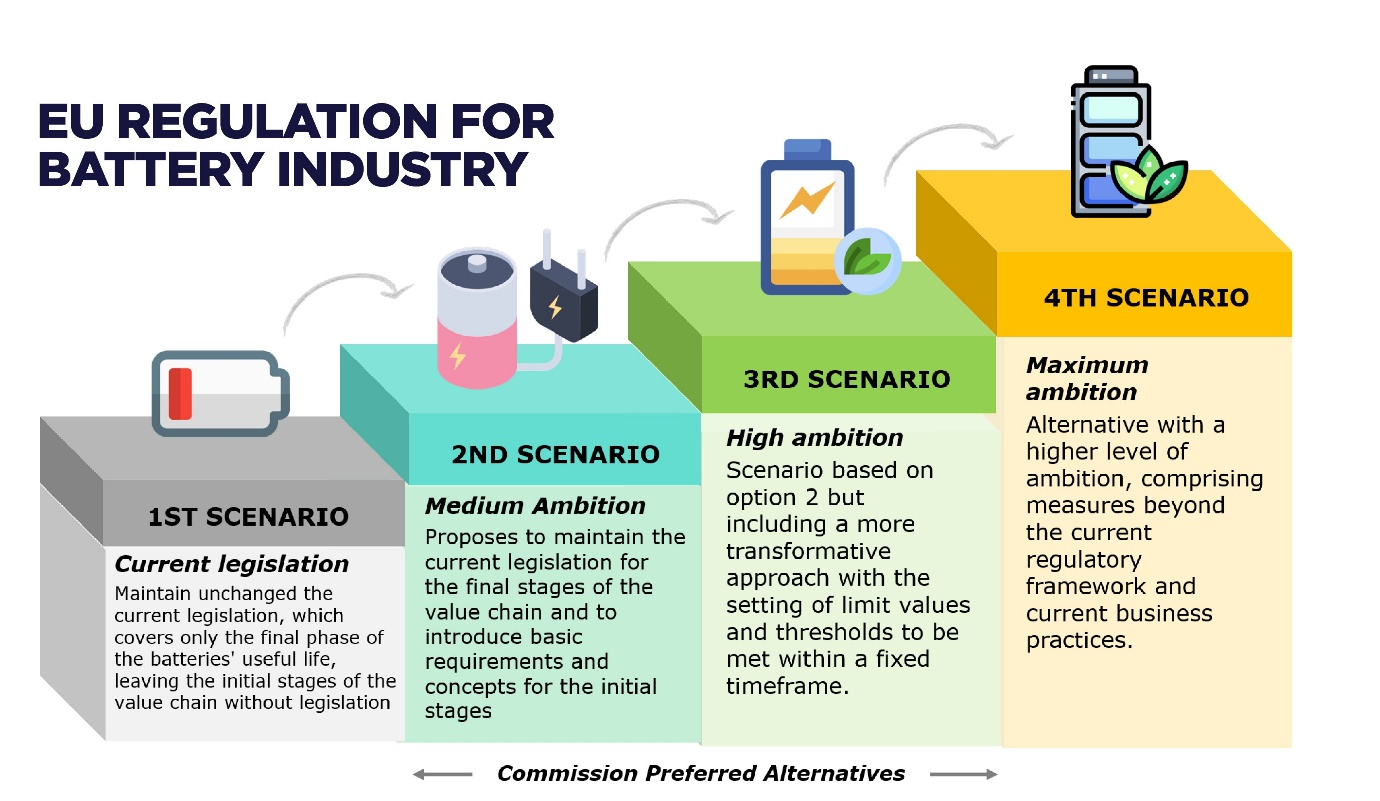
Image
Courtesy: cicenergiegune
Global
Policy and Regulatory Frameworks Supporting Battery Recycling
To
ensure proper handling of batteries, several governments are creating stricter
rules to require LIB recycling.
European
Union (EU): The EU has mandated
that in 2028, 90% of cobalt and copper, along with nickel, as well as 50%
of lithium from end-of-life batteries must be recovered. These goals will grow
up to 95% and up to 80%, respectively, in 2032 (Chemical &
Engineering News, 2023).
United
States: The Inflation Reduction Act of
2022 provides several subsidies and ample tax incentives for companies
investing into domestic battery recycling infrastructure (Environmental
Protection Agency, 2023).
China: China is the world’s largest LIB producer. Because of
this, China has put in place strict recycling rules making EV producers
guarantee correct battery management when they are no longer useful
(International Energy Agency, 2023).
The
Path Forward: How to Scale Up LIB Recycling
To
accelerate global LIB recycling efforts, the industry must focus on:
Investment
in R&D: Further funding is
needed in order to develop adequately cost-effective and scalable recycling
technologies.
Stronger
Public Awareness Campaigns: Persuading people
to return used batteries to collection centers can
greatly raise the amount of recycling.
Design
for Recycling (DfR): Battery manufacturers should prioritize modular
designs that simplify, and also adequately ease, battery disassembly coupled
with material recovery.
Collaboration
Across Industries: Through collaboration
industries, governments, automakers, as well as tech companies must work
together towards creation of a closed-loop battery supply chain.
Conclusion
Recycling
lithium-ion batteries is no longer optional, but is required for a more
sustainable energy future. As electric vehicle adoption greatly goes up and the
need for lithium-ion batteries steadily keeps rising, expanding recycling
initiatives will be important in cutting raw material reliance, decreasing
expenses, and lessening ecological effects.
The
combination of regulatory support and public participation with technical
innovation can set the stage for a more circular battery economy. This will
ensure that LIBs remain a foundation under clean energy without contributing to
ecological degradation.