Beyond Waste: Rethinking Solid Waste Management in India
Published on April 25, 2026
Beyond
Waste: Rethinking Solid Waste Management in India
India’s waste management narrative is undergoing a fundamental shift. For years, the focus remained on collection, transportation, and disposal. Today, the conversation is evolving towards something far more transformative: reimagining waste as a resource.
With rapid urbanization, changing consumption patterns, and increasing environmental pressures, India generates over 160,000–170,000 tonnes of municipal solid waste every day, amounting to nearly 62 million tonnes annually. Yet only 50–55% of this waste is scientifically processed, while a significant portion continues to be landfilled or leaks into the environment.
This is no longer just a waste management issue. It is a systems challenge, and more importantly, a systems opportunity.
The Hidden Value in Waste
India’s waste stream is not just a burden; it is a largely untapped resource.
Over 50% of waste is biodegradable, suitable for composting and bioenergy
Millions of tonnes of plastic, paper, and metal can be reintegrated into production cycles
Non-recyclable waste can be converted into Refuse Derived Fuel (RDF) for industrial use
At the same time, per capita waste generation is steadily rising from 0.34–0.5 kg per day and is expected to reach 0.7 kg per day in the coming years. (Source: CleanIndiaJournal)
The gap between waste generation and resource recovery highlights a critical inefficiency. Bridging this gap is where India’s sustainability transition lies.
The Shift to a Circular Economy
India is gradually moving away from the traditional linear model of “take, use, dispose” towards a circular economy, where materials are continuously reused, recycled, and recovered.
The Solid Waste Management Rules, 2026 mark a significant step in this direction. The rules introduce a more structured, accountable, and technology-driven framework that focuses on:
- Four-stream segregation at source
- Decentralized waste processing systems
- Extended responsibility for bulk waste generators
- Integration of waste into industrial energy systems through Refuse Denied Fuel (RDF) mandates
- Digital tracking of waste flows for transparency and compliance
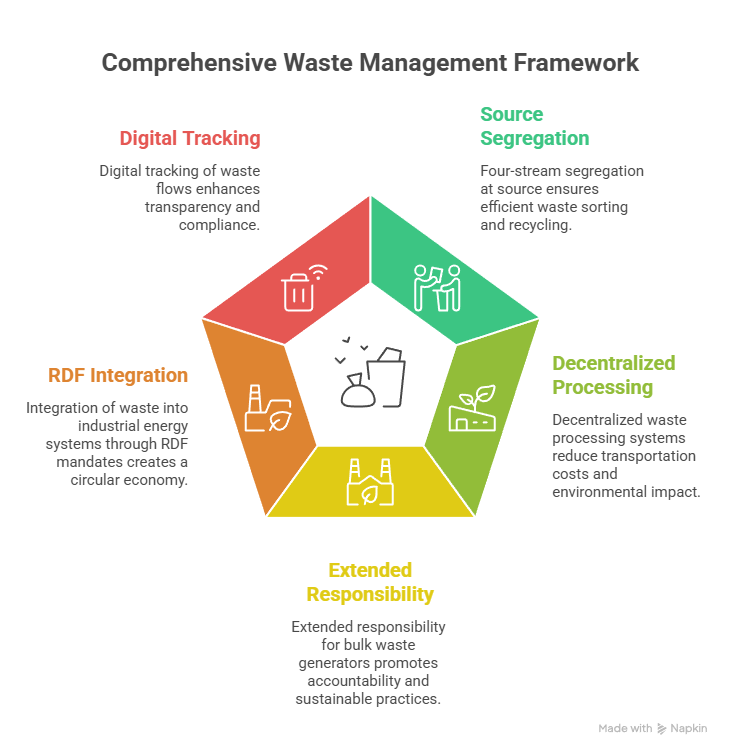
This shift reflects a deeper transformation: waste is no longer seen as an
endpoint, but as part of a continuous material lifecycle.
Learn more about new rules at: [https://www.linkedin.com/feed/update/urn:li:activity:7444586822971682817/]
Cities as Resource Recovery Systems
India’s cities, often viewed as waste hotspots, have the potential to become resource recovery hubs.
With the right systems in place:
- Organic waste can be converted into compost or biogas
- Dry waste can be processed through Material Recovery Facilities (MRFs)
- Non-recyclable waste can be utilized in energy and industrial applications
Well-designed systems can enable 60–70% of waste to be recovered or processed efficiently, significantly reducing landfill dependency. This transformation redefines cities not as waste generators, but as urban mines of valuable resources.
Industry as a Catalyst in the Waste Value
Chain
One of the most important shifts in India’s waste ecosystem is the growing role of industry.
Through mandates like RDF usage, industries such as cement and waste-to-energy plants are now part of the waste value chain. This creates:
· A stable demand for processed waste
· Financial incentives for better segregation and processing
· Stronger linkages between municipal systems and industrial operations
· Waste management is no longer confined to municipalities. It is becoming an integrated economic activity.
Why
Behaviour Matters More Than Infrastructure
Despite policy advancements and infrastructure development, one
factor continues to determine success: human behaviour.
Segregation at source remains inconsistent and, mixed waste continues to
undermine recycling systems.
Waste management cannot succeed if it is treated as someone else’s responsibility. It requires participation from:
- Households
- Institutions
- Businesses
- Communities
Because ultimately, waste management is not just a technical issue, it is a collective behavioural system.
The Informal Sector: India’s Invisible
Backbone
India’s waste ecosystem is unique in its reliance on the informal sector. Over 1.5 million waste workers contribute to recycling and material recovery. Yet, their integration into formal systems remains limited.
Recognizing and integrating this workforce can:
- Improve efficiency of recycling systems
- Reduce environmental leakage
- Create inclusive and sustainable livelihoods
A circular economy in India cannot be built without leveraging this existing ecosystem.
Case Study: Indore – A Model for Circular
Waste Management
GOBARdhan Bio-CNG Plant
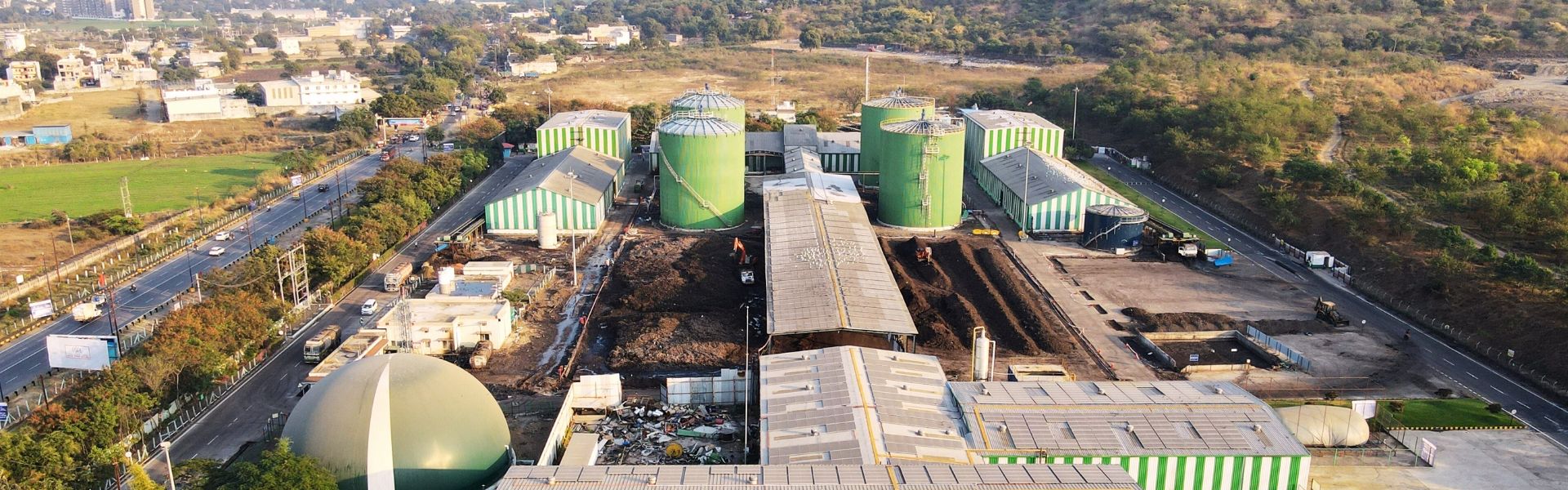
Source: Swachh Bharat Mission Urban
GOBARdhan Bio-CNG Plant
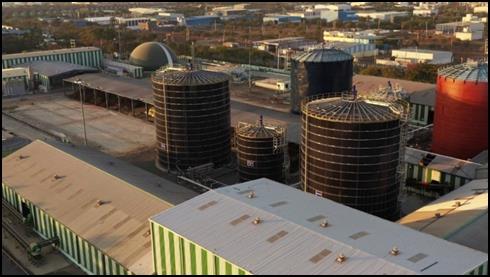
Source: Swachh Bharat Mission Urban
Indore
Municipal Corporation- Waste segregation centre
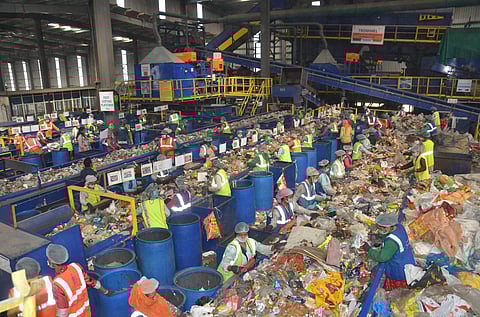
Source: Knocksense
The transformation of Indore demonstrates what is possible when policy, governance, and citizen participation align.
Consistently ranked as India’s cleanest city under the Swatch Bharat Swachh Survekshan, Indore has evolved into a leading example of circular waste management in practice.
What Sets Indore Apart
- 100% door-to-door waste collection
- Strict source segregation practices
- Decentralized composting and biomethanation systems
- Efficient Material Recovery Facilities (MRFs)
- Strong user fee and penalty mechanisms
Turning Waste into Resources
- Organic waste is converted into compost and bio-CNG, powering public transport
- Plastic waste is recycled and used in infrastructure
- Non-recyclables are processed into RDF for industrial use
The Key
Insight
- Indore’s success is not just about infrastructure. It is about behavioural change.
- Segregation has become a habit, not a rule. This cultural shift is what sustains the system.
From
Policy to Practice: The Execution Challenge
India has made measurable progress, but the next phase will depend on execution
and scalability.
Key priorities include:
- Strengthening segregation at source
- Expanding decentralized processing infrastructure
- Scaling circular economy markets
- Enhancing digital tracking and enforcement systems
Most importantly, India must shift from managing waste to designing systems that minimize waste generation itself.
Designing a Waste-Free Future
India’s waste management journey is entering a new phase. One that is not defined by how efficiently waste is disposed, but by how effectively it is reintegrated into the economy.
The question is no longer: “How do we manage waste?”
It is: “How do we design systems where waste does not
exist?”
At IDREA, we believe that waste management is no longer a standalone sector, it
is a critical pillar of the energy transition and circular economy.
The future lies in integrating policy, technology, and behaviour to create
systems where waste becomes a resource, not a liability. With the right mix of
policy, participation, and innovation, India can transform its waste challenge
into a model of resource efficiency, circularity, and sustainability.