World Wetlands Day: Nature’s Silent Climate Warriors
Published on February 12, 2026
World Wetlands
Day: Nature’s Silent Climate Warriors
“Take
care of the wetlands, and the wetlands will take care of us.”
As a slight rise from the water at dawn and birds
begin their morning calls, a wetland comes to life. To a common and casual
observer, it may look like a silent stretch of marsh or a shallow lake. But
beneath the still surface lies one of nature’s most powerful and hardworking
ecosystems—the wetland.
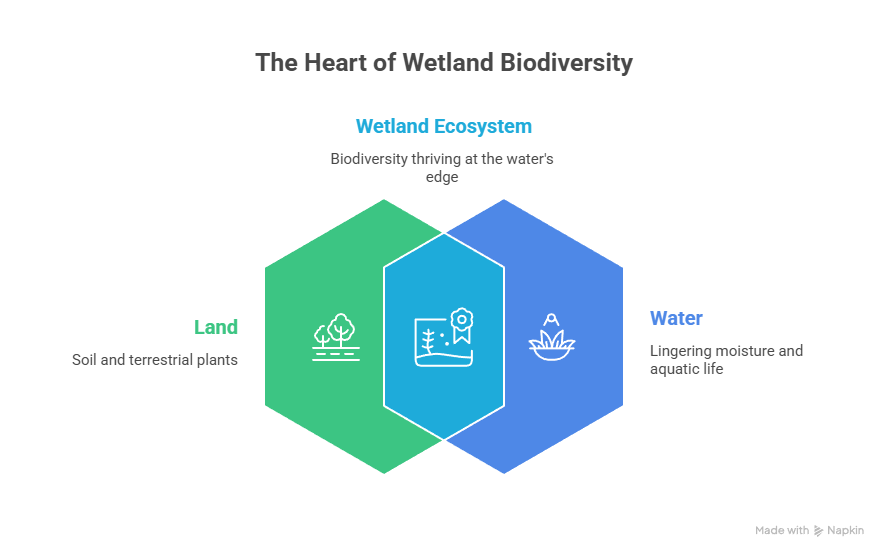
A land that lives with water – Wetland. Sometimes they
are flooded, sometimes they are saturated; they exist where water lingers that
are long enough to shape the soil, plants, and the life that depends on them.
This steady relationship with water creates with whole wetland ecosystem,
a minute, small switch balance between land and the water that supports this
overall biodiversity.
When diving deep into knowing the wetlands, they
actually have different forms. We can see tall grasses rooted in open marshes,
while trees anchored in water form swamps. In non-tropical areas, fen and bogs
develop, feeding through groundwater or rainfall, slowly capturing carbon-rich
peat over centuries. In coastlines, you can also see mangroves and tidal flats
rise and fall with the tides. Though they may take different appearances, all
these wetlands contribute to one defining trait: they are shaped by water and
sustained by it.
Plants that survive and grow abundantly in wetlands
are known as Hydrophytes. They are adapted to survive in waterlogged soils
where oxygen is scarce. It creates a balance in life cycles of many organisms,
such as they compensate sediments, filtering pollution-causing agents, and
providing food and shelter for fish, birds and numerous other life species.
Every element we see in this world has a purpose to
fulfil, and wetlands are no exception. Some have their origin from glaciers,
leaving behind depressions that are filled with meltwater. Others form when
rivers flood their plains, spreading life-giving silt across the land. Even
animals like beavers contribute by building dams, shaping wetland landscapes.
Over time, nature engineered these systems with remarkable precision.
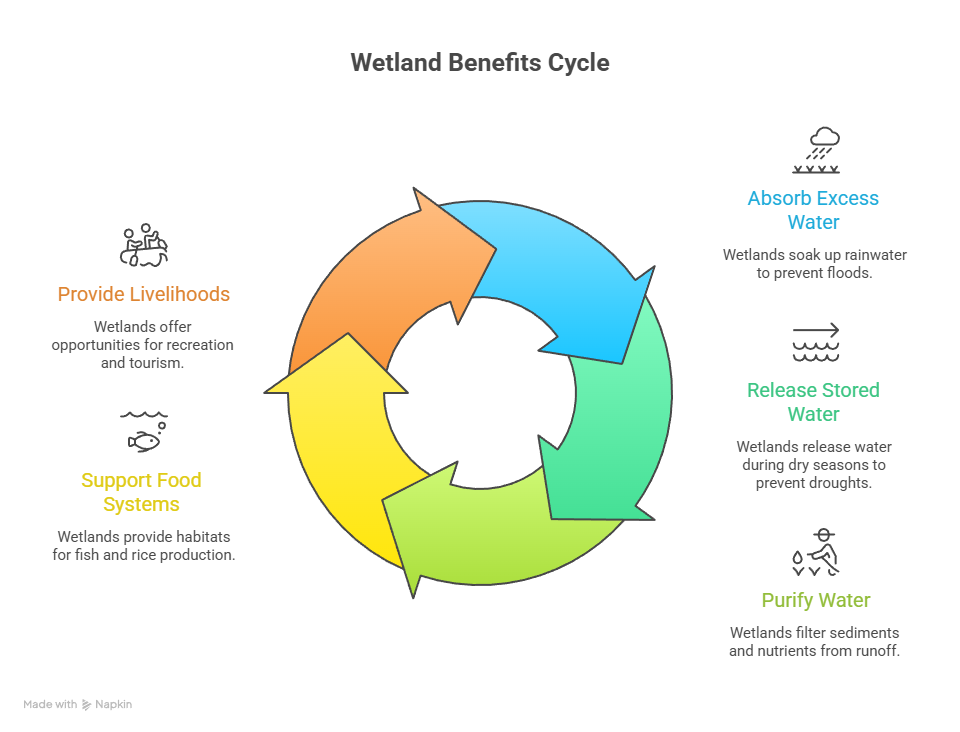
Want to see the benefits of wetlands in action? See
them during extreme rainfall. They act like a giant sponge, absorbing excess
water and reducing floods. And even during dry seasons, they release stored
water, preventing droughts.
Their purpose does not end here; wetlands also function
as a natural water purifier, trapping sediments and absorbing nutrients such as
nitrogen and phosphorus from agricultural runoff before they reach rivers and
lakes.
As mentioned earlier, wetlands silently support global
food systems; nearly two-thirds of fish species and a careful share of rice
production depend on this ecosystem. Beyond its benefits from providing
food, wetlands provide livelihoods, recreation opportunities, and spaces for
tourism through birdwatching, boating, or simply reconnecting with nature.
Wetlands are not farmed in the traditional sense, but
they are managed with care—through controlled water flows, sustainable fishing,
and traditional farming systems that work with nature rather than against it.
Wetlands in
Conservation and Policy
Recognising their importance, wetlands are protected
under various frameworks. In India, the Wetlands Conservation and Management Rules, 2017,
provide a regulatory framework for identifying, conserving, and managing
wetlands.
Globally, organisations like the International Union for Conservation of Nature (IUCN) play
a key role in promoting wetland protection, restoration, and sustainable use.
A Call on
World Wetlands Day
Every year on 2 February, the world observes World
Wetlands Day, marking the adoption of the Ramsar Convention on Wetlands. These
landscapes remind us of a simple but effective truth: “The strongest climate
solutions are often the quietest”. These wetlands are life-support systems
that protect our water, food, and climate. Protecting wetlands is not an
environmental luxury—it is a development necessity.
They are, truly, nature’s silent climate warriors.