World Wildlife Day 2026: Medicinal and Aromatic Plants – Conserving Health, Heritage & Livelihoods
Published on March 3, 2026
World Wildlife Day
2026: Medicinal and Aromatic Plants – Conserving Health, Heritage &
Livelihoods
In the
quiet corners of the Amazon rainforest, a healer carefully harvests the bark of
a sacred tree. In the high mountains of the Himalayas, farmers tend rows of
aromatic herbs that have sustained their families for generations. In
laboratories across the world, researchers analyse compounds extracted from
wild plants that may hold the key to treating devastating diseases.
These are
not isolated stories. They are interconnected threads in the tapestry of life
on Earth - and they are increasingly at risk.
World
Wildlife Day 2026 shines a spotlight on medicinal and aromatic plants - one of
nature’s most valuable yet vulnerable resources. As we mark this global
observance on March 3rd, we are called to recognize that conserving these
botanical treasures is inseparable from protecting human health, cultural
heritage, and economic resilience.
The
Health Imperative: Medicine From the Wild
Medicinal
and aromatic plants are not merely complementary to modern healthcare - they
are foundational to it.
The World
Health Organization estimates that nearly 80% of the world’s population relies
on traditional medicine for primary healthcare, with medicinal plants forming
the backbone of these systems. Even in industrialized nations, approximately
25% of pharmaceutical drugs are derived directly from plants.
From
anti-cancer compounds to treatments for heart disease and infections,
plant-derived molecules continue to shape medical innovation. Yet many species
with untapped medicinal potential remain unstudied - and at risk of
disappearing before their benefits are understood.
Protecting
plant biodiversity is therefore not only an environmental priority; it is a
matter of global health security.
Cultural
Heritage: Millennia of Knowledge at Risk
Beyond
their chemical properties, medicinal and aromatic plants embody centuries, even
millennia - of accumulated human wisdom.
Indigenous
peoples and local communities have long served as custodians of botanical
knowledge. Their understanding of plant properties, sustainable harvesting
practices, and holistic healing systems represents an invaluable intellectual
heritage.
This
knowledge is often transmitted orally, through generations. When plant species
disappear, so too does the cultural memory associate with them.
Conserving
medicinal plants therefore also means safeguarding living traditions and
recognizing the rights and leadership of many old and tribal communities in
biodiversity stewardship.
Economic
Lifelines: Livelihoods Rooted in Nature
For
millions of people, medicinal and aromatic plants are not abstract conservation
concerns - they are daily economic realities.
The global
trade in medicinal plants exceeds $60 billion annually. From collectors and
cultivators to processors and traders, vast value chains depend on plant
resources.
In
countries such as Ethiopia, India, Nepal, and Madagascar, the harvesting and
cultivation of medicinal plants provide essential income for rural and
forest-dependent communities. Women, who constitute a significant portion of
plant collectors in many regions, gain financial independence and
decision-making power through this work.
The
essential oil and aromatic plant industries - from lavender fields in Provence
to frankincense harvesters in Somalia - sustain regional economies while
offering pathways to nature-based enterprise.
However,
high demand can lead to overharvesting. Collectors often receive minimal
compensation compared to the final product value. Without fair trade
mechanisms, sustainable harvesting protocols, and community-centered
benefit sharing, economic value can accelerate ecological decline.
The
solution lies in aligning conservation with equitable economic models.
India: A Leader in Managing Cultural heritage,
biodiversity and livelihood:
India is
one of the world’s megadiverse countries and a global leader in traditional
medicine systems. Medicinal and aromatic plants underpin preventive healthcare
practices, rural livelihoods, essential oil industries, and growing herbal
value chains.
Across
India, species such as:
- Tulsi (Ocimum tenuiflorum)
- Ashwagandha (Withania
somnifera)
- Camphor (Cinnamomum camphora)
- Curry Leaf (Murraya
koenigii)
- Giloy (Tinospora
cordifolia)
- Haritaki (Terminalia chebula)
- Kalmegh (Andrographis paniculata)
- Lemongrass (Cymbopogon citratus)
- Neem (Azadirachta
indica)
- Palmarosa (Cymbopogon martinii)
- Vetiver / Khus (Chrysopogon
zizanioides)
illustrate
how biodiversity supports health systems, heritage, livelihoods, and economic
stability. Protecting these species strengthens our country’s:
- Preventive
healthcare and wellness industries
- Agroforestry
and climate-resilient farming
- Rural
entrepreneurship
- Ecological
restoration efforts
India’s
leadership in sustainable cultivation, research, and policy frameworks can
significantly influence global conservation outcomes.
Biodiversity
and the Sustainable Development Goals
The
conservation of medicinal and aromatic plants directly advances:
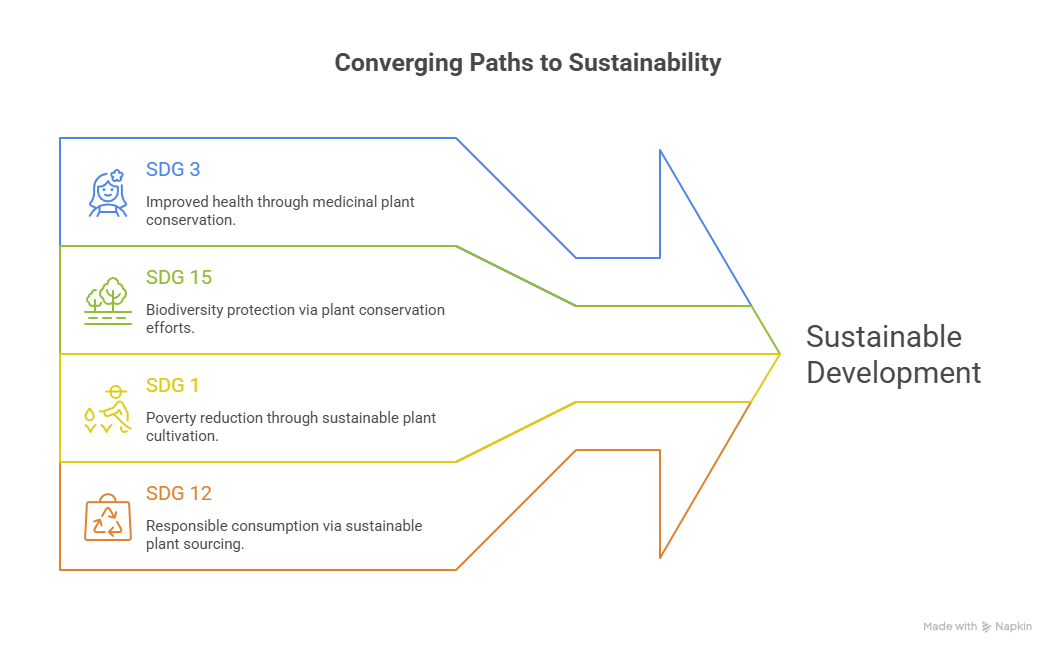 This theme reinforces a critical
insight: climate action and biodiversity protection are inseparable.
This theme reinforces a critical
insight: climate action and biodiversity protection are inseparable.
The
Silent Crisis: Medicinal Plants Are Disappearing
Despite
their importance, medicinal and aromatic plants face accelerating threats.
An
estimated 15,000 medicinal plant species are currently threatened with
extinction. Many have never undergone formal scientific study, meaning
potential treatments for cancer, antibiotic-resistant infections, and chronic
diseases could be lost forever.
The
drivers are clear:
- Habitat destruction
- Unsustainable harvesting
- Climate change
- Expansion of agriculture and
urban development
In
biodiversity-rich regions such as Madagascar and parts of South Asia,
deforestation and illegal extraction are placing high-value species under
severe pressure.
This is a
convergence of crises - ecological, health-related, cultural, and economic.
Community-Based
Conservation: Evidence That It Works
Encouragingly,
conservation and livelihoods can reinforce each other.
- In Nepal, community forest
user groups manage medicinal plant harvesting through quotas informed by
scientific monitoring, ensuring regeneration and equitable benefit
sharing.
- In South Africa’s Western
Cape, cooperative models for rooibos cultivation demonstrate how
certification and direct market access can reward sustainable land
stewardship.
- In the Amazon, Indigenous
communities are engaging in benefit-sharing agreements with research
institutions to ensure that traditional knowledge is respected and
compensated.
These
examples show that when local communities are empowered, biodiversity
protection becomes more durable and just.
The
Path Forward: What Must Be Done
At IDREA,
we believe collective action is essential to safeguard medicinal and aromatic
plants:
- Strengthen
habitat protection & restoration
- Support
sustainable cultivation to reduce pressure on wild stocks
- Promote
ethical and traceable supply chains
- Recognize
tribal land rights and traditional knowledge
- Invest
in scientific research and conversation programs.
- Encourage
responsible consumer choices.
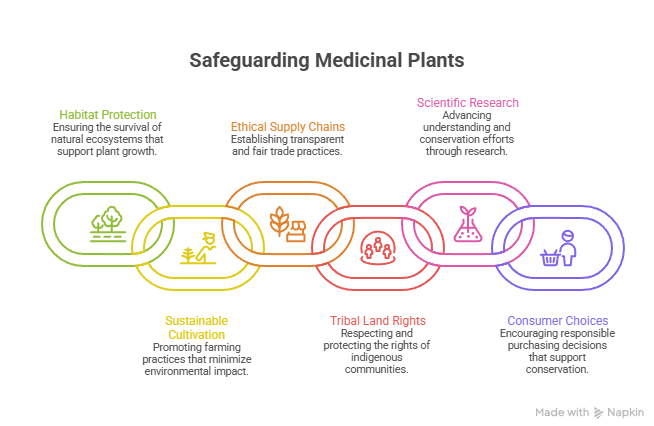
Conservation
must be integrated - ecological, social, and economic dimensions working
together.
A Call
to Action to Protect Our Biodiversity
Medicinal
and aromatic plants are not niche resources. They are living infrastructure
that sustains health systems, cultural identity, and livelihoods across
continents.
Their
disappearance would represent more than biodiversity loss - it would signal the
erosion of human resilience itself.
At IDREA,
we recognize that biodiversity conservation, climate resilience, and
sustainable development are deeply interconnected. Protecting medicinal and
aromatic plants is not only on ecological responsibility – it is an investment
in long-term human wellbeing.
This World
Wildlife Day 2026, we reaffirm our commitment to protecting nature by integrate
conservation, community empowerment, and sustainable economic models.